When the fast-growing aerospace company Hermeus needed to test its revolutionary propulsion system, it found an ideal partner in the University of Notre Dame.
“It’s rare to find a direct-connect facility available for industry use,” explains Amber Shell, a propulsion test engineer at Hermeus. “At Notre Dame Power & Propulsion (ND P&P), we could build a test cell tailored to our specifications, which was instrumental for our progress.”
The first significant technology Hermeus tested at Notre Dame was Chimera, a turbine-based combined-cycle engine designed to achieve hypersonic flight. Hermeus needed to test whether the engine could seamlessly transition between two modes: a turbojet mode, optimized for low-Mach supersonic speeds, and a ramjet mode, designed to accelerate to Mach 5 (five times the speed of sound, or 3,800 miles per hour) and beyond.
“That transition capability was a huge first for us as a company,” Shell notes. The rigorous tests at Notre Dame P&P documented and confirmed that Chimera could successfully switch modes as designed—a critical achievement in hypersonic flight technology. The partnership’s success encouraged Hermeus to return to Notre Dame in 2024 to test a new pre-cooler technology essential for transitioning from ground tests to flight tests.
A New Five-Year Plan and a Broader Approach
Building on five years of successful collaboration, Notre Dame and Hermeus have launched a new five-year strategic partnership. The agreement aims to accelerate the development of next-generation hypersonic technology, enhancing U.S. economic competitiveness and national security.
This new phase will move beyond one-off projects to a more broader approach. Its goals include:
Developing New Capabilities: The partners will jointly identify and fill critical gaps in hypersonic testing infrastructure. This involves leveraging Notre Dame's existing facilities and co-developing new technologies.
Workforce Development: The collaboration will create a pipeline for the next generation of scientists and engineers through research experiences, internships, and more for Notre Dame students.
Building a National Consortium: Notre Dame and Hermeus will explore establishing a broader consortium, bringing together partners from academia, industry, and government to advance the nation's hypersonic test and evaluation capabilities. They will also jointly pursue funding to support these goals.
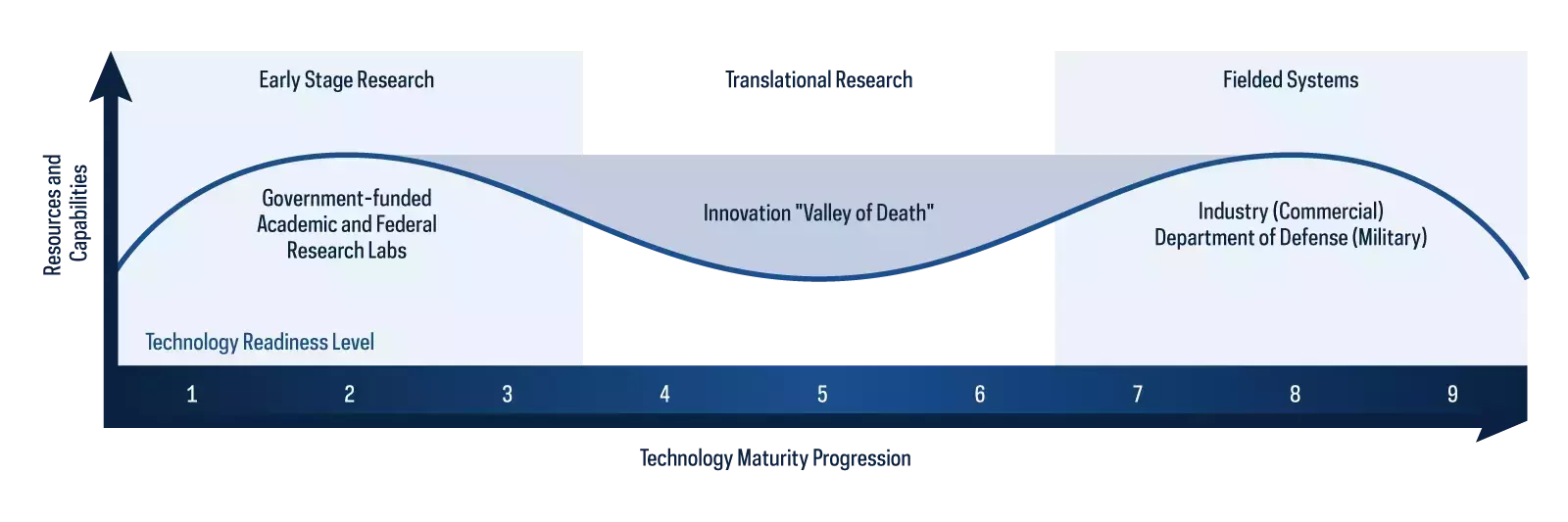
Crossing the Innovation Valley of Death
Joshua Szczudlak, Senior Associate Director at Notre Dame P&P, highlights the synergy between the two organizations. “Our two organizations have specialties on either side of the ‘valley of death’ that stands in the way of so many innovations,” he says. “Notre Dame connects back to fundamental research, and Hermeus focuses on product development and delivery. By merging in the middle at a place like Notre Dame Power & Propulsion, we’re able to create a smoother pathway for new technologies.”
To learn more about Notre Dame Power & Propulsion’s research, please visit ND P&P's website.
Contact
Erin Fennessy / Writing Program Manager
Notre Dame Research / University of Notre Dame
efenness@nd.edu / +1 574-631-8183
research.nd.edu / @UNDResearch / linkedin.com/company/undresearch
About Notre Dame Research
The University of Notre Dame is a private research and teaching university inspired by its Catholic mission. Located in South Bend, Indiana, its researchers are advancing human understanding through research, scholarship, education, and creative endeavor in order to be a repository for knowledge and a powerful means for doing good in the world. For more information, please visit NDR's website or NDR's LinkedIn.
Originally published by at research.nd.edu on November 03, 2025.