<?xml version="1.0" encoding="UTF-8"?>
<?xml-stylesheet type="text/xsl" href="/stylesheets/feed.atom.xml" media="screen"?>
<feed xml:lang="en-US" xmlns="http://www.w3.org/2005/Atom">
  <id>tag:powerpropulsion.nd.edu,2005:/news-events/news</id>
  <link rel="alternate" type="text/html" href="https://powerpropulsion.nd.edu"/>
  <link rel="self" type="application/atom+xml" href="https://powerpropulsion.nd.edu/news-events/news.atom"/>
  <id>tag:powerpropulsion.nd.edu,2005:/latest</id>
  <title>Notre Dame Power &amp; Propulsion | News</title>
  <updated>2026-05-06T13:30:00-04:00</updated>
  <link rel="alternate" type="text/html" href="https://powerpropulsion.nd.edu/"/>
  <link rel="self" type="application/atom+xml" href="https://powerpropulsion.nd.edu//news-events/news.atom"/>
  <subtitle>A research and development organization focused on high-complexity, large-scale testing and advanced computational analysis in propulsion, energy, and thermal technologies.</subtitle>
  <entry>
    <id>tag:powerpropulsion.nd.edu,2005:News/181463</id>
    <published>2026-05-06T13:30:00-04:00</published>
    <updated>2026-05-06T13:13:51-04:00</updated>
    <link rel="alternate" type="text/html" href="https://powerpropulsion.nd.edu/news-events/news/notre-dame-power-propulsion-announces-its-2026-summer-internship-cohort/"/>
    <title>Notre Dame Power &amp; Propulsion announces 2026 summer internship cohort</title>
    <summary type="text">
      <![CDATA[Notre Dame Power &amp; Propulsion (ND P&amp;P) at the University of Notre Dame is pleased to announce its 2026 undergraduate summer internship cohort. The incoming interns—Dalton Leitz, David Scully, Luke Tocco, and Caitlyn Zito, all rising juniors at…]]>
    </summary>
    <content type="html">
      <![CDATA[<p><a href="https://powerpropulsion.nd.edu/">Notre Dame Power &amp; Propulsion</a> (ND P&amp;P) at the University of Notre Dame is pleased to announce its 2026 undergraduate summer internship cohort. The incoming interns—Dalton Leitz, David Scully, Luke Tocco, and Caitlyn Zito, all rising juniors at Notre Dame, studying mechanical or aerospace engineering—will be paired with staff and industry mentors to gain real-world engineering experience in design, testing, and analysis at the White Field and Ignition Park facilities.</p>
<p>ND P&amp;P’s work centers on translational research, using knowledge and discoveries regarding the fundamental sciences to inform technological applications. A University research center, ND P&amp;P partners with industry and government in the development of advanced technologies for conventional and high Mach air-breathing propulsion, energy generation, advanced thermal management, and energy storage solutions.</p>
<p>The immersive internship program spans 10 weeks, during which students work closely with both a staff member at ND P&amp;P and an industry mentor, and attend formative events such as professional development workshops and weekly Lunch and Learns.</p>
<p>“A valuable takeaway for the students in this program is the exposure to real-world applications—being able to work alongside both engineering and business professionals to see how prototyping actually happens,” said <a href="https://research.nd.edu/people/mark-ross/">Mark Ross</a>, the Research Liaison Program Manager at ND P&amp;P. “That experience is immediately transferable and valuable to our interns after graduation, whether they go on to graduate school, industry, or other professional schools.”</p>
<p>In addition to their on-site work, interns will have the opportunity to present their work to industry partners at the end of the program, as well as to participate in Notre Dame’s Summer Undergraduate Research Symposium and Three Minute Thesis (3MT) Competition.</p>
<p>“The university environment is a unique place for this sort of internship, since students are able to work with faculty on their applied research and at the same time have the opportunity to engage with their wealth of knowledge on the science behind the devices,” Ross added.</p>
<p>ND P&amp;P has a long history of undergraduate involvement, as undergraduate students were instrumental in some of the facility’s early work, collaborating alongside faculty, graduate students, and staff. This mutually beneficial relationship has remained a key part of the ND P&amp;P environment, with the internship program growing to include industry partners—connecting talented students to career opportunities at a critical stage in their academic training.</p>
<p>Scully, a sophomore studying aerospace engineering in the <a href="https://ame.nd.edu/">Department of Aerospace and Mechanical Engineering</a>, said he is interested in the design and testing of aerospace systems and is discerning how to apply this interest professionally.</p>
<p>“I hope to finish the internship with not only an enhanced skill set, but a better understanding of where I want to direct my career,” Scully said. “Without the standard demands of the academic year, I am looking forward to dedicating my full attention to our research, learning from the experienced team at ND P&amp;P, and seeing a project through from start to finish.”</p>
<p>To learn more about the internship program, please visit the <a href="https://powerpropulsion.nd.edu/get-involved/internship/">Notre Dame Power &amp; Propulsion website</a>.</p>
<p><strong>Contact</strong></p>
<p>Erin Fennessy / Writing Program Manager</p>
<p>Notre Dame Research / University of Notre Dame</p>
<p>efenness@nd.edu / +1 574-631-8183</p>
<p>research.nd.edu / @UNDResearch / <a href="http://linkedin.com/company/undresearch">linkedin.com/company/undresearch</a></p>
<p><strong>About Notre Dame Research</strong></p>
<p>The University of Notre Dame is a private research and teaching university inspired by its Catholic mission. Located in South Bend, Indiana, its researchers are advancing human understanding through research, scholarship, education, and creative endeavor in order to be a repository for knowledge and a powerful means for doing good in the world. For more information, please visit <a href="http://research.nd.edu">NDR's website</a> or <a href="https://www.linkedin.com/company/undresearch/">NDR's LinkedIn</a>.</p>]]>
    </content>
    <link rel="enclosure" type="image/jpeg" href="https://powerpropulsion.nd.edu/assets/658823/ndtl_080323_summer_intern_project_62.jpg" title="A bearded man in clear safety glasses, olive shirt, explains an open electrical panel to two students in a lab."/>
    <author>
      <name>Monica Sayler</name>
    </author>
  </entry>
  <entry>
    <id>tag:powerpropulsion.nd.edu,2005:News/177110</id>
    <published>2025-12-08T13:21:00-05:00</published>
    <updated>2025-12-08T14:26:52-05:00</updated>
    <link rel="alternate" type="text/html" href="https://powerpropulsion.nd.edu/news-events/news/alumni-founder-of-carbon-capture-start-up-receives-nsf-funding-to-collaborate-with-notre-dame-researchers/"/>
    <title>Alumni founder of carbon-capture start-up receives NSF funding to collaborate with Notre Dame researchers</title>
    <summary type="text">
      <![CDATA[…]]>
    </summary>
    <content type="html">
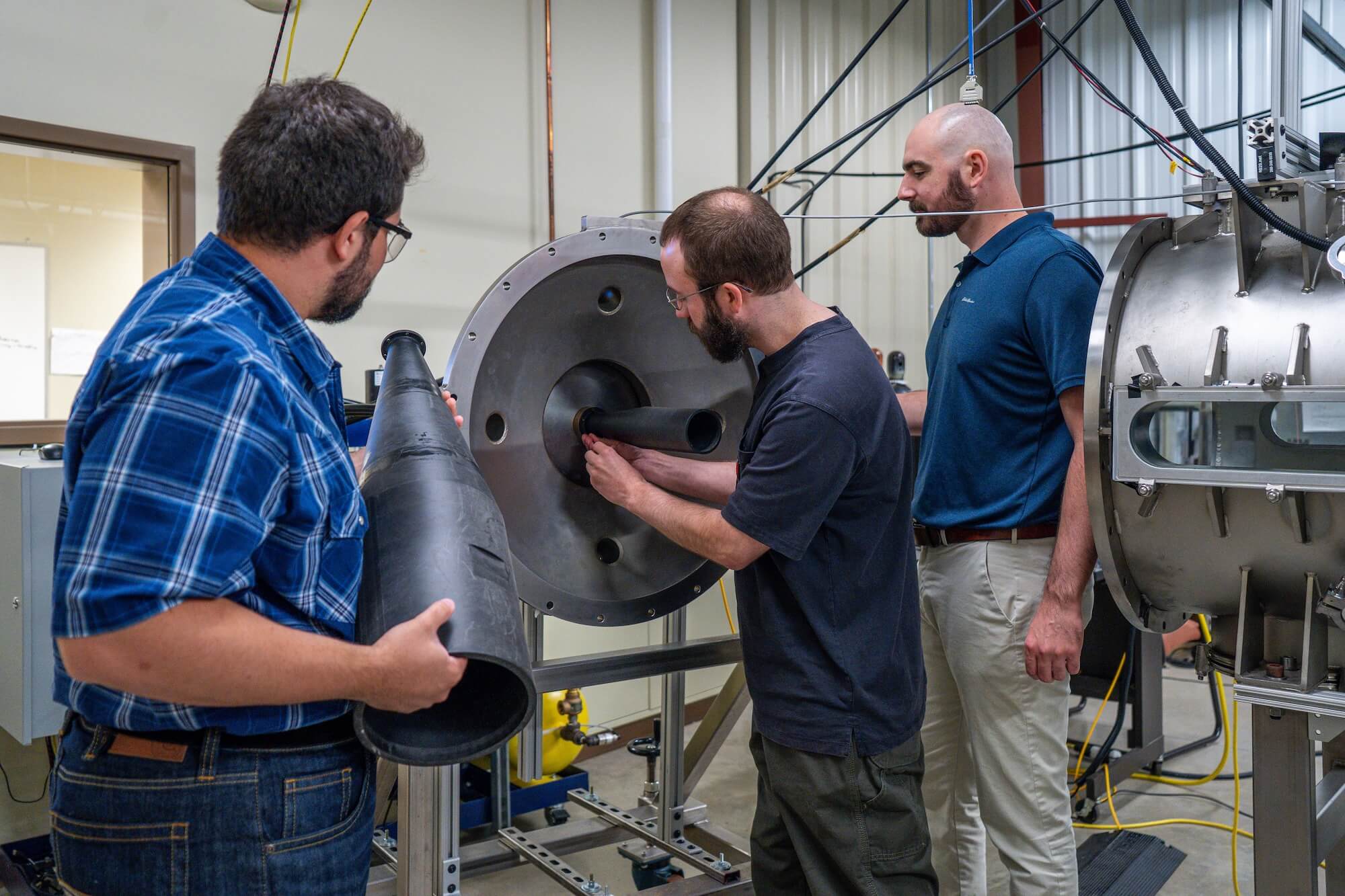
      <![CDATA[<figure class="image image-default"><img src="https://research.nd.edu/assets/641036/fullsize/image1.jpg" alt="Three men work on scientific equipment in a lab. A man in a blue plaid shirt holds a black conical object, while another with a beard inserts a black tube into a large silver metallic apparatus. A bald man in a blue polo observes the process." width="2000" height="1333">
<figcaption>Graduate student Alin Stoica, postdoctoral scholar Philip Lax, and Alec Houpt, AME Ph.D. ‘19, swap out nozzles on the High Enthalpy Arc Tunnel (ACT1), also called the ND Arcjet, at Notre Dame’s White Field research facility. Photo by Angelic Rose Hubert.</figcaption>
</figure>
<p>Alec Houpt, who earned his doctorate from the <a href="https://ame.nd.edu/">Department of Aerospace and Mechanical Engineering</a> (AME) at the University of Notre Dame in 2020, will collaborate with <a href="https://ame.nd.edu/faculty/sergey-leonov/">Sergey Leonov</a>, research professor in AME, to pursue the development of a supersonic nozzle designed to freeze and capture carbon dioxide and water from industrial exhaust.</p>
<p>Houpt and Leonov, who previously served as Houpt’s doctoral advisor, received <a href="https://www.nsf.gov/awardsearch/showAward?AWD_ID=2508025">Phase I funding </a>from the National Science Foundation’s <a href="https://www.nsf.gov/funding/opportunities/sbirsttr-phase-i-nsf-small-business-innovation-research-small-business">Small Business Tech Transfer</a> (STTR) program to advance work already underway at Houpt’s startup, <a href="https://www.inertial.xyz/">Inertial</a>. The project aims to freeze carbon dioxide and water out of industrial exhaust streams by pushing the exhaust through an axisymmetric supersonic nozzle, while swirling the stream to separate the heavier and denser frozen particles from the surrounding gas. The captured carbon, which has been prevented from being emitted into the atmosphere, would then be sold to a downstream customer looking to turn it into a value-added product, like fuel or building materials.</p>
<p>The funds provided in the STTR Phase I grant will bring Houpt’s initial nozzle designs into the supersonic wind tunnels at Notre Dame’s <a href="https://engineering.nd.edu/research-overview/facilities-and-resources/hessert-laboratory-for-aerospace-research-and-hessert-at-white-field/">White Field Research Laboratory</a>. Here, Leonov’s research team will test various geometries and swirling rates to optimize nozzle design for the freezing and separation of water and CO2.</p>
<p>Collaborating with Leonov at White Field brings the duo around full circle to the earliest origins of Houpt’s idea for Inertial.</p>
<p>Back in graduate school, Houpt was running an experiment with a Mach-6 supersonic nozzle on the High Enthalpy Arc Tunnel (ACT1) at White Field. When air or any gas moves through a supersonic nozzle, the flow drops in temperature and pressure as the internal energy of the gas is converted into kinetic energy. To prevent freezing on the backend of the nozzle, the temperature of the whole wind tunnel is generally raised with a heating system.</p>
<p>One time, however, the heater didn’t kick on at all and the nozzle flow condensed. Ten years after the fact, Houpt has now returned to his experience with the foggy equipment fluke. Last year, he got together with Leonov and a current postdoctoral scholar, Philip Lax, whose doctoral scholarship focused on condensation in supersonic and hypersonic wind tunnels, to entertain the possibility of a specialized nozzle that is intentionally designed to freeze and capture CO2.</p>
<p>“That's not uncommon for supersonic, hypersonic labs in general, to unintentionally freeze carbon dioxide or whatever their flow gas is,” Houpt explained. “It's never the goal, it’s always an error, but we'd like to flip the script on that.”</p>
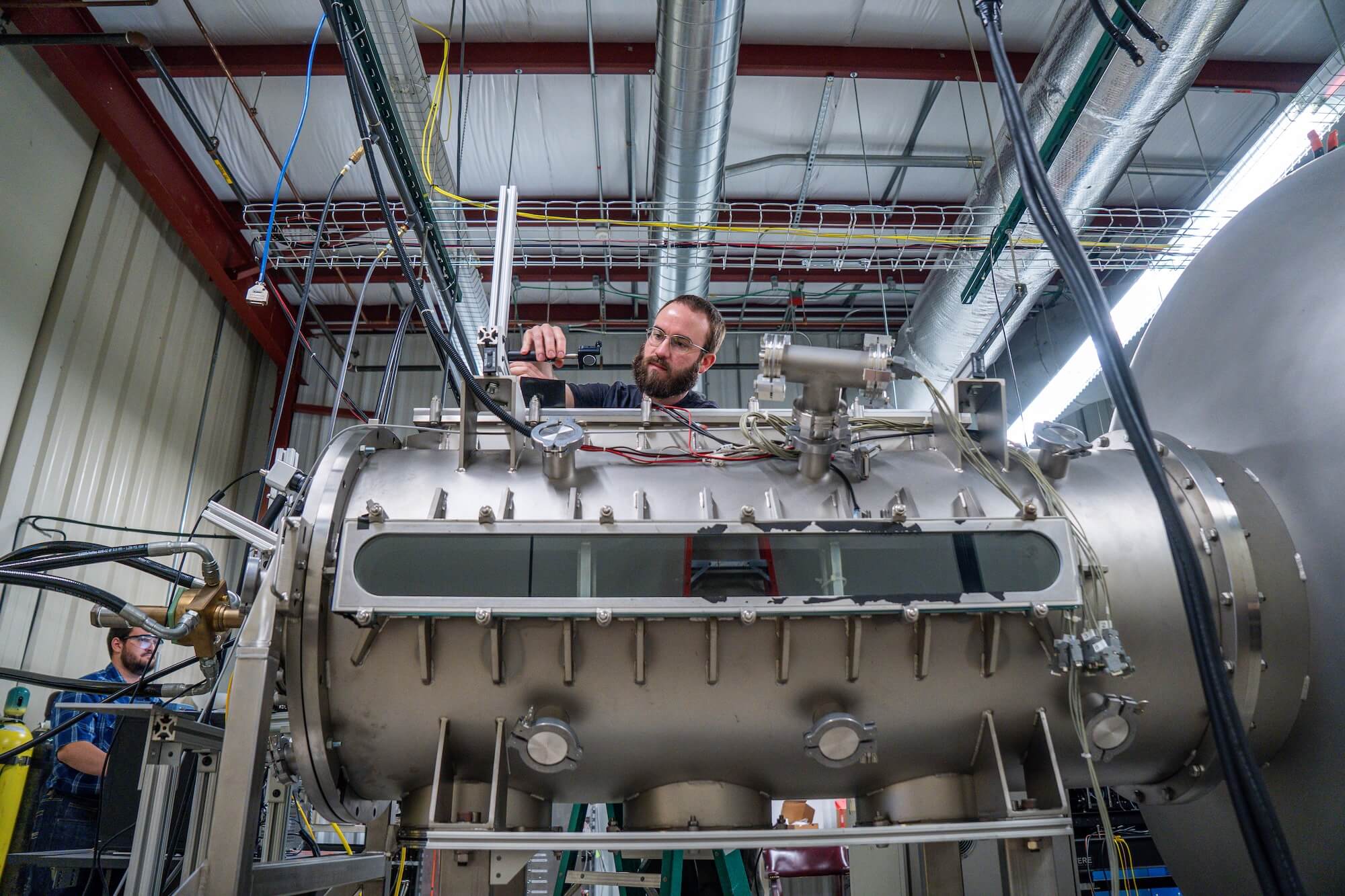
<figure class="image image-default"><img src="https://research.nd.edu/assets/641037/fullsize/image2.jpg" alt="A bearded man in glasses and a black shirt leans over a large, silver cylindrical scientific instrument with a viewing window, carefully adjusting a component with a tool. He is focused in a lab." width="2000" height="1333">
<figcaption>Philip Lax makes adjustments to the High Enthalpy Arc Tunnel (ACT1), also called the ND Arcjet, at Notre Dame’s White Field research facility. Photo by Angelic Rose Hubert.</figcaption>
</figure>
<p>Wind tunnels are large tube-like structures used to study the aerodynamic properties of objects, such as aircraft and spacecraft, and their components, including engines and nosecones. The tunnel generates a uniform flow of air around a stationary object, which simulates flight in a controlled environment. Researchers can then analyze how air moves in and around an object and optimize designs accordingly.</p>
<p>The characteristics of the industrial exhaust systems Houpt is looking to retrofit are not so different from those of wind tunnels, whose high pressure and uniformity mimic the flow he’s hoping to process from industrial partners.</p>
<p>To control how fast the air flows into the test section of a supersonic wind tunnel, a nozzle contracts the flow until it is moving at the speed of sound, or Mach 1, then expands the stream to accelerate it beyond Mach 1. The nozzles on research wind tunnels like those at White Field are designed to provide the most uniform flow possible. Part of maintaining a predictable, repeatable, uniform flow is avoiding condensation, which can happen if the temperature of the flow drops too drastically during expansion.</p>
<p>The nozzle Houpt is designing will become the centerpiece of a wind tunnel technology retrofitted to the exhaust ducts of power plants and similar industrial facilities. The apparatus will route the flue gas output from plant operations into a compressor, which will increase the pressure, and then push it through the nozzle, first contracting the gas, then expanding it, like a research wind tunnel.</p>
<p>But instead of trying to optimize the gas’ expansion for uniformity, Houpt is seeking to optimize it for phase change. The optimal nozzle will facilitate a conversion from heat energy to kinetic energy so significant that the carbon dioxide and water within the flue gas reliably freezes, a phenomenon which Leonov and Lax documented while developing the Phase I proposal.</p>
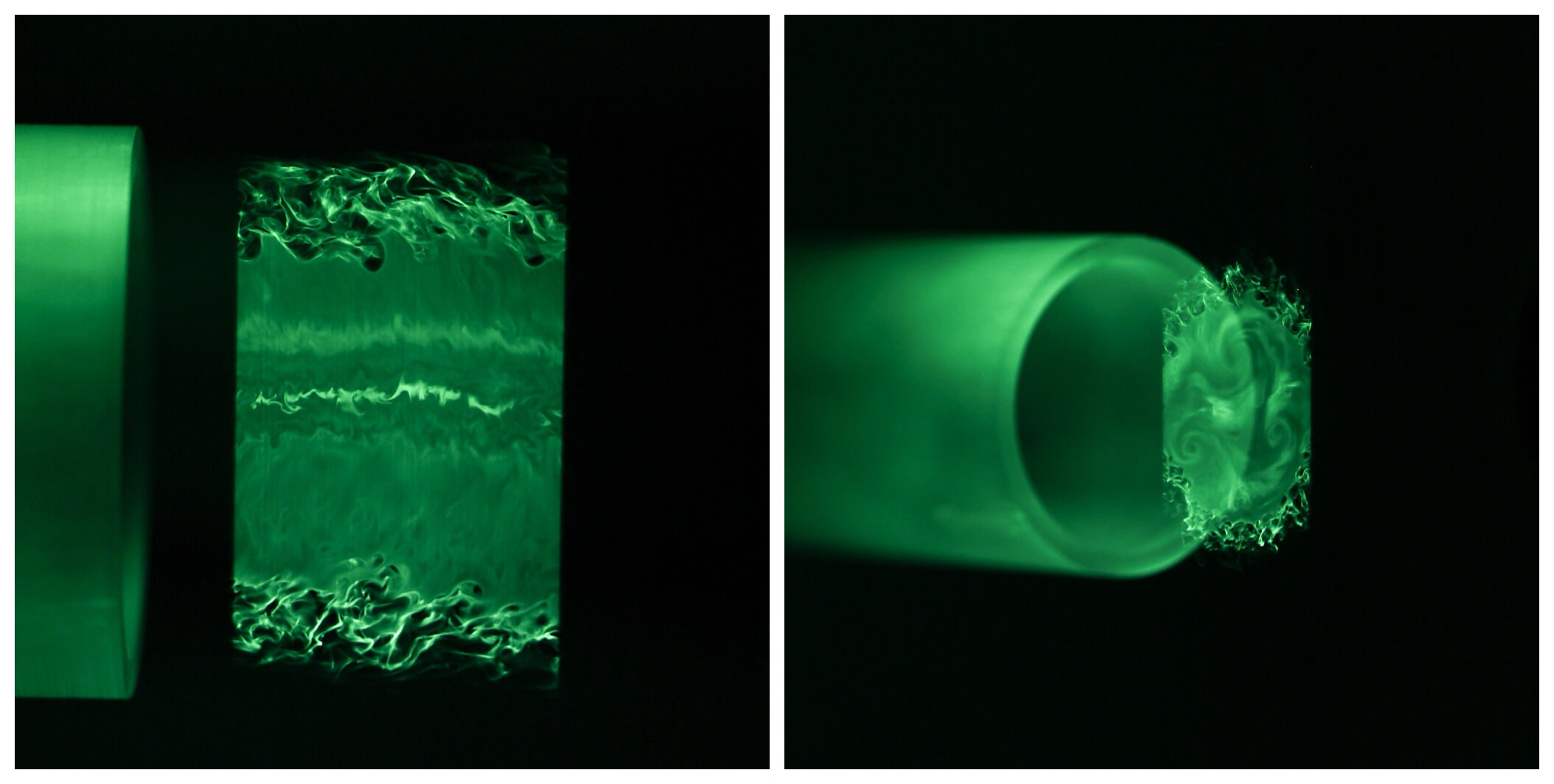
<figure class="image image-default"><img src="https://research.nd.edu/assets/641056/fullsize/image.jpg" alt="Two panels display glowing green turbulent fluid against a black background. Left shows chaotic flow next to a green pipe. Right reveals swirling vortices from a pipe opening." width="2108" height="1064">
<figcaption>CO2 condensate is visible at the exit of a swirling Mach 6 nozzle, visualized using a nanosecond pulsed 532 nanometer laser sheet. The laser light is scattered by the condensed CO2 particles, then imaged with a high-speed camera. The nozzle is visible on the left due to light scattering. Credit: Philip Lax.</figcaption>
</figure>
<p>Though proven, freezing is only half the story. Limited experimental work related to actually removing the frozen particles from the larger flow has been performed.</p>
<p>“Right now, the frozen flow just stays in one line once it leaves the nozzle,” Houpt said. “We're swirling everything and trying to get the frozen solids to migrate to the outside, so we can essentially isolate them while letting the rest of the exhaust flow by.”</p>
<p>Houpt's swirling technique aims to take advantage of the fact that frozen particles are heavier and have more momentum than the surrounding gas. When the mixture is spun, everything inside wants to keep moving in a straight line, but the spinning forces them into a circle. This creates a push toward the center of the spin. The heavier particles, however, have more resistance to this inward push, so they end up getting thrown outward to the edges of the spinning flow.</p>
<p>Upcoming experiments will test and refine the geometry of Houpt’s nozzle design, as well as investigate swirling rates, to optimize the inertial separation. Once the first small prototype is perfected, the team can scale up—literally.</p>
<p>“One of the great things about aerospace engineering is that everything's based on ratios,” Houpt said. “So you can perfect the nozzle on a small scale, then just make the area of ratios bigger, and it functions the same.”</p>
<p>While Houpt is only at the threshold of a lengthy technology maturation process, his choice to reconnect with Leonov’s research team and collaborate with Notre Dame engineers reflects his long-term aspirations.</p>
<p>In order for Inertial’s technology to be considered ready for commercial operations, the nozzle must be capable of capturing 1,000 metric tons of carbon dioxide per year. To reach this benchmark, Houpt’s design will be scaled up to at least three times larger than the initial prototype.</p>
<p>“The initial stages of developing, testing, and transitioning from the lab to industry, like in the case of Alec’s system, are critical but challenging to sustain,” Leonov said. “We’re very grateful to have received the funding for collaborative testing with Inertial. Financial support like this is invaluable for pursuing the development of novel technologies to their fullest extent, especially in such a critical area as the mitigation of carbon emissions.”</p>
<p>Leonov added, “One of the great additional benefits of this project is the exposure Notre Dame students will receive to exciting areas of engineering, which will, in turn, be the catalyst for a new generation of highly-skilled engineers to enter the workforce.”</p>
<p>After proving the nozzle design capable at White Field in Phase I—a subscale design which can capture roughly 50 tons of CO2 per year—Houpt will seek Phase II funding from the NSF and a partnership with engineers at <a href="https://powerpropulsion.nd.edu/">Notre Dame Power &amp; Propulsion</a> (ND P&amp;P).</p>
<p>“White Field’s testing capabilities will get Inertial started with the fundamental science and development,” said Joshua Szczudlak, senior associate director at <a href="https://powerpropulsion.nd.edu/">ND P&amp;P</a>. “Our role at P&amp;P is to help Alec move his concept from the benchtop experiment into a larger, practical system. We’re able to leverage both our deep knowledge of turbomachinery and our broader experience in technology transition to support that process, while staying within the Notre Dame ecosystem."</p>
<p>To learn more about Notre Dame Power &amp; Propulsion’s research, please visit <a href="https://powerpropulsion.nd.edu/">ND P&amp;P's website</a>.</p>
<p><strong> </strong></p>
<p><strong>Contact</strong></p>
<p>Erin Fennessy / Writing Program Manager</p>
<p>Notre Dame Research / University of Notre Dame</p>
<p>efenness@nd.edu / +1 574-631-8183</p>
<p>research.nd.edu / @UNDResearch / <a href="http://linkedin.com/company/undresearch">linkedin.com/company/undresearch</a></p>
<p><strong>About Notre Dame Research</strong></p>
<p>The University of Notre Dame is a private research and teaching university inspired by its Catholic mission. Located in South Bend, Indiana, its researchers are advancing human understanding through research, scholarship, education, and creative endeavor in order to be a repository for knowledge and a powerful means for doing good in the world. For more information, please visit <a href="http://research.nd.edu">NDR's website</a> or <a href="https://www.linkedin.com/company/undresearch/">NDR's LinkedIn</a>.<strong id="docs-internal-guid-b3219256-7fff-a7f2-51f3-3e27ba46bfb4"><br></strong></p>
<p class="attribution">Originally published by <span class="rel-author">Erin Fennessy</span> at <span class="rel-source"><a href="https://research.nd.edu/news-and-events/news/alumni-founder-of-carbon-capture-start-up-receives-nsf-funding-to-collaborate-with-notre-dame-researchers/">research.nd.edu</a></span> on <span class="rel-pubdate">December 08, 2025</span>.</p>]]>
    </content>
    <link rel="enclosure" type="image/jpeg" href="https://powerpropulsion.nd.edu/assets/641297/image1.jpg" title="Three men work on scientific equipment in a lab. A man in a blue plaid shirt holds a black conical object, while another with a beard inserts a black tube into a large silver metallic apparatus. A bald man in a blue polo observes the process."/>
    <author>
      <name>Erin Fennessy Lawlor</name>
    </author>
  </entry>
  <entry>
    <id>tag:powerpropulsion.nd.edu,2005:News/176227</id>
    <published>2025-11-03T14:17:00-05:00</published>
    <updated>2025-11-03T14:17:04-05:00</updated>
    <link rel="alternate" type="text/html" href="https://powerpropulsion.nd.edu/news-events/news/notre-dame-and-hermeus-deepen-partnership-to-advance-hypersonic-technology-with-new-5-year-agreement/"/>
    <title>Notre Dame and Hermeus Deepen Partnership to Advance Hypersonic Technology with New 5-Year Agreement</title>
    <summary type="text">
      <![CDATA[When the fast-growing aerospace company Hermeus needed to test its revolutionary propulsion system, it found an ideal partner in the University of Notre Dame. “It’s rare to find a direct-connect facility available for industry use,” explains Amber Shell, a propulsion test engineer at Hermeus.…]]>
    </summary>
    <content type="html">
      <![CDATA[<p>When the fast-growing aerospace company Hermeus needed to test its revolutionary propulsion system, it found an ideal partner in the University of Notre Dame.</p>
<p>“It’s rare to find a direct-connect facility available for industry use,” explains Amber Shell, a propulsion test engineer at Hermeus. “At Notre Dame Power &amp; Propulsion (ND P&amp;P), we could build a test cell tailored to our specifications, which was instrumental for our progress.”</p>
<p>The first significant technology Hermeus tested at Notre Dame was Chimera, a turbine-based combined-cycle engine designed to achieve hypersonic flight. Hermeus needed to test whether the engine could seamlessly transition between two modes: a turbojet mode, optimized for low-Mach supersonic speeds, and a ramjet mode, designed to accelerate to Mach 5 (five times the speed of sound, or 3,800 miles per hour) and beyond.</p>
<p><iframe width="710" height="399" allowfullscreen="allowfullscreen" frameborder="0" src="https://www.linkedin.com/embed/feed/update/urn:li:ugcPost:6999018428636299264?compact=1" title="Embedded post"></iframe></p>
<p>“That transition capability was a huge first for us as a company,” Shell notes. The rigorous tests at Notre Dame P&amp;P documented and confirmed that Chimera could successfully switch modes as designed—a critical achievement in hypersonic flight technology. The partnership’s success encouraged Hermeus to return to Notre Dame in 2024 to test a new pre-cooler technology essential for transitioning from ground tests to flight tests.</p>
<h4>A New Five-Year Plan and a Broader Approach</h4>
<p>Building on five years of successful collaboration, Notre Dame and Hermeus have launched a new five-year strategic partnership. The agreement aims to accelerate the development of next-generation hypersonic technology, enhancing U.S. economic competitiveness and national security.</p>
<p>This new phase will move beyond one-off projects to a more broader approach. Its goals include:</p>
<p>Developing New Capabilities: The partners will jointly identify and fill critical gaps in hypersonic testing infrastructure. This involves leveraging Notre Dame's existing facilities and co-developing new technologies.</p>
<p>Workforce Development: The collaboration will create a pipeline for the next generation of scientists and engineers through research experiences, internships, and more for Notre Dame students.</p>
<p>Building a National Consortium: Notre Dame and Hermeus will explore establishing a broader consortium, bringing together partners from academia, industry, and government to advance the nation's hypersonic test and evaluation capabilities. They will also jointly pursue funding to support these goals.</p>
<h4>Crossing the Innovation Valley of Death</h4>
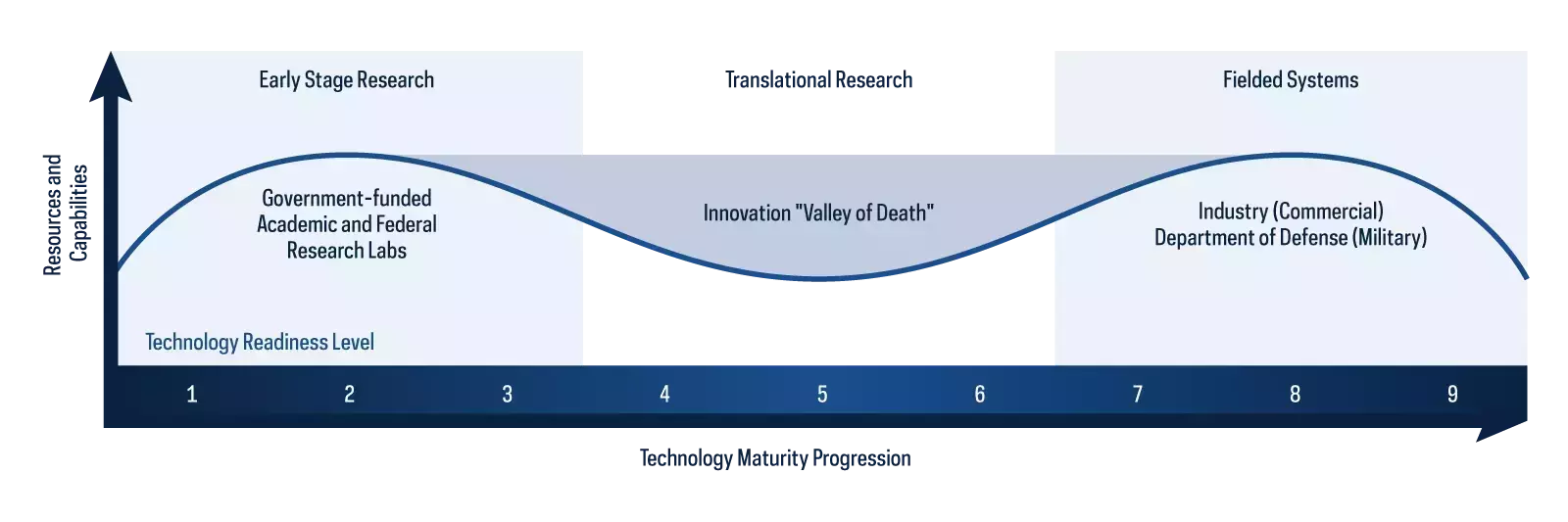
<p><a href="https://research.nd.edu/people/joshua-szczudlak/">Joshua Szczudlak</a>, Senior Associate Director at Notre Dame P&amp;P, highlights the synergy between the two organizations. “Our two organizations have specialties on either side of the ‘valley of death’ that stands in the way of so many innovations,” he says. “Notre Dame connects back to fundamental research, and Hermeus focuses on product development and delivery. By merging in the middle at a place like Notre Dame Power &amp; Propulsion, we’re able to create a smoother pathway for new technologies.”</p>
<figure class="image image-default"><img src="https://research.nd.edu/assets/635306/fullsize/ndtl_gap_graph_03.webp" alt="Chart depicts the Innovation 'Valley of Death' model, mapping Technology Readiness Levels (TRL 1-9) to Impact. Early Stage Research (TRL 1-3, Government/Academic Labs) precedes the &quot;Valley of Death&quot; (TRL 4-6, an Investment Gap), leading to Fielded Systems (TRL 7-9, Industry/DoD)." width="1600" height="533"></figure>
<p>To learn more about Notre Dame Power &amp; Propulsion’s research, please visit <a href="https://powerpropulsion.nd.edu/">ND P&amp;P's website</a>.</p>
<p><strong> </strong></p>
<p><strong>Contact</strong></p>
<p>Erin Fennessy / Writing Program Manager</p>
<p>Notre Dame Research / University of Notre Dame</p>
<p>efenness@nd.edu / +1 574-631-8183</p>
<p>research.nd.edu / @UNDResearch / <a href="http://linkedin.com/company/undresearch">linkedin.com/company/undresearch</a></p>
<p><strong>About Notre Dame Research</strong></p>
<p>The University of Notre Dame is a private research and teaching university inspired by its Catholic mission. Located in South Bend, Indiana, its researchers are advancing human understanding through research, scholarship, education, and creative endeavor in order to be a repository for knowledge and a powerful means for doing good in the world. For more information, please visit <a href="http://research.nd.edu">NDR's website</a> or <a href="https://www.linkedin.com/company/undresearch/">NDR's LinkedIn</a>.</p>
<p class="attribution">Originally published by <span class="rel-author">Brett Beasley</span> at <span class="rel-source"><a href="https://research.nd.edu/news-and-events/news/notre-dame-and-hermeus-deepen-partnership-to-advance-hypersonic-technology-with-new-5-year-agreement/">research.nd.edu</a></span> on <span class="rel-pubdate">November 03, 2025</span>.</p>]]>
    </content>
    <link rel="enclosure" type="image/png" href="https://powerpropulsion.nd.edu/assets/636909/ndtl.png" title="Metallic combustion chamber glowing reddish-orange at the exhaust, with a blue flame below, set inside a silver quilted test cell."/>
    <author>
      <name>Brett Beasley</name>
    </author>
  </entry>
  <entry>
    <id>tag:powerpropulsion.nd.edu,2005:News/168316</id>
    <published>2024-11-18T15:16:00-05:00</published>
    <updated>2024-11-18T15:17:08-05:00</updated>
    <link rel="alternate" type="text/html" href="https://powerpropulsion.nd.edu/news-events/news/notre-dame-opens-worlds-first-large-mach-10-quiet-wind-tunnel/"/>
    <title>Notre Dame opens world’s first Large Mach 10 Quiet Wind Tunnel</title>
    <summary type="text">
      <![CDATA[On Saturday, November 9, 2024, the University of Notre Dame marked the successful opening of a Large Mach 10 Quiet Wind Tunnel, the first and only facility of its kind in the world. The facility supplies a unique environment for exploring hypersonic flight dynamics, turbulence, flight control, and…]]>
    </summary>
    <content type="html">
      <![CDATA[<p>On Saturday, November 9, 2024, the University of Notre Dame marked the successful opening of a Large Mach 10 Quiet Wind Tunnel, the first and only facility of its kind in the world. The facility supplies a unique environment for exploring hypersonic flight dynamics, turbulence, flight control, and propulsion. Designed for high-quality flow and cost-effective testing, the facility represents a major milestone in hypersonic research. In addition to advancing aerospace technology, it will play a crucial role in training and workforce development, bringing substantial benefits to both Indiana and the broader United States.</p>
<p>“Our new Large Mach 10 Quiet Wind Tunnel embodies Notre Dame’s commitment to boundary-breaking research in aerospace engineering and fluid dynamics,” said <a href="https://research.nd.edu/people/jeffrey-rhoads/">Jeffrey F. Rhoads</a>, vice president for research and professor in the <a href="https://ame.nd.edu/">Department of Aerospace and Mechanical Engineering</a>. “We are proud to serve the nation by advancing our hypersonic capabilities and enabling tomorrow’s hypersonic workforce through this one-of-a-kind facility.”</p>
<p>The new facility was dedicated at a ribbon-cutting ceremony hosted over the Veteran’s Day weekend, which featured remarks from Ambassador Joe Donnelly, Admiral Christopher Grady, Congressman Pat Fallon, Chairman Mike Rogers, and Dean Patricia Culligan.</p>
<p>Donnelly, who represented the State of Indiana in both the U.S. House of Representatives and the U.S. Senate and also served as the U.S. Ambassador to the Holy See, said, “This is a testament to ‘God. Country. Notre Dame.’ The technology developed here will help us stand up and protect our nation and keep our children and grandchildren safe…It will ensure that our nation is stronger and that we have an even better future.”</p>
<p>Admiral Grady, the Vice Chairman of the Joint Chiefs of Staff and the nation’s second-highest-ranking military officer, said, “This facility will allow researchers to conduct experiments that could lead to the development of faster and more effective systems, thus improving our military's conventional capabilities, enhancing deterrence, ensuring that we can respond swiftly to emerging threats, and promising our safety and security in this very uncertain world.”</p>
<p>Grady added, “The implications of hypersonic research extend far beyond defense, fostering economic growth and technological collaboration. As we push the boundaries of what is possible, we will also be leading advancements in commercial aerospace, energy efficiency, and environmental sustainability. By developing technologies that harness hypersonic systems and speeds, we can envision a future where air travel is faster, safer, and more efficient, thus connecting the world like never before...In addition, the cross-disciplinary nature of hypersonic research will foster innovation and train the next generation of our workforce of engineers, scientists, and skilled artisans to think beyond conventional boundaries. ”</p>
<p>The new wind tunnel adds a new chapter to Notre Dame’s history of excellence in aerospace-related innovation. That history dates back to 1882, when Notre Dame student Albert Francis Zahm, who would later become a faculty member at the University, <a href="https://engineering.nd.edu/about-the-college/150-years/#:~:text=in%20the%20basement.-,1882%20%E2%80%93%20Pioneering%20Aeronautics,-Albert%20F.%20Zahm">built</a> one of the world’s first wind tunnels on campus. Zahm was among the first to conclude that slender, curved surfaces shaped like a bird’s wing would make the best airplane wings and propellers.</p>
<p>The new Large Mach 10 Quiet Wind Tunnel joins an outstanding group of facilities on campus that carry on Notre Dame’s tradition of aerospace innovation. These include the <a href="https://engineering.nd.edu/research-overview/facilities-and-resources/hessert-laboratory-for-aerospace-research-and-hessert-at-white-field/">Hessert Laboratory for Aerospace Research and Hessert at White Field</a>, the <a href="https://flowpac.nd.edu/">Institute for Flow Physics and Control</a> (FlowPAC), and <a href="https://ndtl.nd.edu/">NDTL Propulsion &amp; Power</a>.</p>
<p>The tunnel was designed by <a href="https://engineering.nd.edu/faculty/thomas-corke/">Thomas Corke</a>, Notre Dame’s Clark Equipment Professor of Aerospace and Mechanical Engineering, along with doctoral students Joseph Heston and Jacob Caldwell. Five additional doctoral students in Corke's research group—Nick Hawley, Alec Jobbins, Will Jordan, Tim Moren, and Alyssa Spencer—contributed to the tunnel design and assembly. Research associate professor Eric Matlis and David Cavalieri, mechanical and aerospace engineer in the <a href="https://edcf.nd.edu/">Engineering and Design Core Facility</a>, also contributed to the tunnel design. The team overcame pandemic-related supply challenges to bring the project to life, working alongside local manufacturers across the Midwest.</p>
<p>The new facility will serve several immediate purposes. It will help address backlogs at Department of Defense testing facilities, enhancing the ability of aerospace companies to move swiftly from concept to prototype. The facility will provide a key resource to support a planned graduate program in hypersonic systems, and it will also create outstanding career opportunities for students interested in military service, aerospace engineering, and research careers at U.S. national laboratories.</p>
<p>"Innovation in hypersonics is a critical priority for ensuring the safety and prosperity of our nation in the 21st century," said Corke. "The foundation of that innovation lies in a workforce with a strong base of expertise in aerospace engineering, materials science, manufacturing, and data analysis—skills essential to tackling the unique challenges posed by hypersonic flight." Corke added, "Building a pipeline for talent into future careers in hypersonic systems is crucial, which means engaging students at all ages and academic levels."</p>
<p>The tunnel was made possible by funding from the Office of the Under Secretary of Defense for Research and Engineering (OUSD(R&amp;E)). For more information on hypersonic research at the University of Notre Dame, please visit the <a href="https://hypersonics.nd.edu/">Hypersonic Systems Initiative website</a>.</p>
<p><strong> </strong></p>
<p><strong>Contact:</strong></p>
<p>Brett Beasley / Research Content Strategy Program Director</p>
<p>Notre Dame Research / University of Notre Dame</p>
<p>bbeasle1@nd.edu / +1 574-631-8183</p>
<p><a href="http://research.nd.edu">research.nd.edu</a> / @UNDResearch</p>
<p><strong> </strong></p>
<p><strong>About Notre Dame Research:</strong></p>
<p>The University of Notre Dame is a private research and teaching university inspired by its Catholic mission. Located in South Bend, Indiana, its researchers are advancing human understanding through research, scholarship, education, and creative endeavor in order to be a repository for knowledge and a powerful means for doing good in the world. For more information, please <a href="https://research.nd.edu/">visit the website</a> or @<a href="https://x.com/UNDResearch">UNDResearch</a>.</p>
<p class="attribution">Originally published by <span class="rel-author">Brett Beasley</span> at <span class="rel-source"><a href="https://research.nd.edu/news-and-events/news/notre-dame-opens-worlds-first-large-mach-10-quiet-wind-tunnel/">research.nd.edu</a></span> on <span class="rel-pubdate">November 18, 2024</span>.</p>]]>
    </content>
    <link rel="enclosure" type="image/jpeg" href="https://powerpropulsion.nd.edu/assets/595159/angieversion.jpg" title="A group of men and women pose for a photo. A person in the center holds large, gold ceremonial scissors, suggesting a ribbon-cutting ceremony. They stand on a blue carpet in front of a navy backdrop with flags and a banner that says &quot;Naval Surface Warfare Center.&quot;"/>
    <author>
      <name>Brett Beasley</name>
    </author>
  </entry>
  <entry>
    <id>tag:powerpropulsion.nd.edu,2005:News/161739</id>
    <published>2024-05-02T13:34:00-04:00</published>
    <updated>2024-05-08T13:19:48-04:00</updated>
    <link rel="alternate" type="text/html" href="https://powerpropulsion.nd.edu/news-events/news/ndtl-shares-aerospace-research-with-local-high-school-students/"/>
    <title>NDTL shares aerospace research with local high school students</title>
    <summary type="text">
      <![CDATA[Mark H. Ross, senior research scientist at NDTL Propulsion &amp; Power, recently stepped out of the lab and into a local high school. Ross, who received his Ph.D. in Aerospace Engineering from Notre Dame in 2014, visited the computer science…]]>
    </summary>
    <content type="html">
      <![CDATA[<p><a href="https://research.nd.edu/people/mark-ross/">Mark H. Ross</a>, senior research scientist at NDTL Propulsion &amp; Power, recently stepped out of the lab and into a local high school. Ross, who received his Ph.D. in Aerospace Engineering from Notre Dame in 2014, visited the computer science and engineering magnet program at South Bend's Riley High School.</p>
<p>Ross spoke about his own academic journey as well as his current research NDTL. He also spoke about upcoming opportunities for students to gain hands-on experience in aerospace engineering through NDTL's internship program.</p>
<p>Seth Ponder, who teaches computer science and engineering at Riley High School, said, "We are immensely grateful to Mark for sharing his expertise and experiences with our students. His insights broadened our students' understanding of aerospace engineering, especially as we start studying different airplane and jet engines in aerospace class at Riley High School."</p>
<p>Joshua Cameron, director of NDTL and concurrent research assistant professor in the Department of Aerospace and Mechanical Engineering in Notre Dame’s College of Engineering, said, "NDTL is proud to be home to researchers like Mark, who contribute their technical expertise to solve engineering problems daily and also make time to share NDTL’s exciting work with members of the local community."</p>
<p>Ross said, "At NDTL, we are excited to do research that translates directly into real-world benefits—through improved products, better designs, and more effective and efficient use of resources. This research can also help students and members of the public see examples of the University's commitment to 'seek discoveries that are significant because of the achievement they represent in a given academic field, but also because they yield benefits for the common good.'"</p>
<p>Local teachers or administrators interested in having a similar talk at their school can contact NDTL at ndtl@nd.edu.</p>
<p>Undergraduate students interested in hands-on learning in aerospace or mechanical engineering can learn more about the Summer Internship Program at NDTL by visiting https://ndtl.nd.edu/get-involved/internship/.</p>
<p><strong> </strong></p>
<p><em><strong>About NDTL</strong></em></p>
<p><em>NDTL is a University of Notre Dame and South Bend, Indiana-based research and development facility that combines the benefits of a vibrant academic research program with a mid-TRL development and validation test facility serving the aerospace and power generation industries. NDTL’s staff expertise includes internal and external aerodynamics, structural dynamics, instrumentation, combustion, computational fluid dynamics, acoustics, and tribology.<strong><br></strong></em></p>
<p><em><strong>Contact:</strong> </em><em>Brett Beasley / Writer and Editorial Program Manager</em></p>
<p><em>Notre Dame Research / University of Notre Dame</em></p>
<p><em>bbeasle1@nd.edu / +1 574-631-8183</em></p>
<p><em>research.nd.edu / @UNDResearch</em></p>
<p><strong><em>About Notre Dame Research:</em></strong></p>
<p><em>The University of Notre Dame is a private research and teaching university inspired by its Catholic mission. Located in South Bend, Indiana, its researchers are advancing human understanding through research, scholarship, education, and creative endeavor in order to be a repository for knowledge and a powerful means for doing good in the world. For more information, please see research.nd.edu or @UNDResearch.</em></p>
<p> </p>]]>
    </content>
    <link rel="enclosure" type="image/jpeg" href="https://powerpropulsion.nd.edu/assets/567344/markross.jpg" title="Mark Ross, senior research scientist at NDTL Propulsion &amp; Power"/>
    <author>
      <name>Brett Beasley</name>
    </author>
  </entry>
  <entry>
    <id>tag:powerpropulsion.nd.edu,2005:News/158286</id>
    <published>2023-11-27T16:04:00-05:00</published>
    <updated>2023-11-27T16:05:02-05:00</updated>
    <link rel="alternate" type="text/html" href="https://powerpropulsion.nd.edu/news-events/news/ndtl-develops-co2-component-test-capability-and-successfully-tests-high-efficiency-transcritical-co2-compressor/"/>
    <title>NDTL Develops CO₂ Component Test Capability and Successfully Tests High Efficiency Transcritical CO₂ Compressor</title>
    <summary type="text">
      <![CDATA[NDTL Propulsion and Power (NDTL) has designed and built a closed test loop and a CO₂ storage and management system to support testing for supercritical and transcritical CO₂ power and thermal management components. The test loop can be installed in NDTL’s 10-megawatt, 5-megawatt, or 3-megawatt test…]]>
    </summary>
    <content type="html">
      <![CDATA[<p>NDTL Propulsion and Power (NDTL) has designed and built a closed test loop and a CO₂ storage and management system to support testing for supercritical and transcritical CO₂ power and thermal management components. The test loop can be installed in NDTL’s 10-megawatt, 5-megawatt, or 3-megawatt test cells to match the power, speed, and flow requirements of a particular test article. NDTL recently completed testing of the first stage of a high-efficiency multistage transcritical CO₂ compressor.</p>
<p>The development of high-efficiency compression systems is important for the design of CO₂-based power and heat pump cycles. Axial compressors inherently have higher efficiency compared to centrifugal and reciprocating machines, but they have not yet been tested or demonstrated using CO₂ as the working fluid. The high fluid density, high power density, and significant real gas effects present technical challenges in designing and testing an axial compressor.</p>
<p>With support from the U.S. Department of Energy (DOE), the team composed of NDTL, Echogen, and the University of Cincinnati is demonstrating the system efficiency advantages of utilizing axial compressors in renewable energy storage systems. This is being accomplished with the design and test of a 3-stage transcritical CO₂ axial compressor.</p>
<p>NDTL designed and fabricated the test loop, performed the mechanical design of the high-power density compressor, and is executing the test program. The University of Cincinnati, employing best practices from air-breathing compressors for aero-propulsion engines, performed the aerodynamic compressor design. Echogen leads the overall program and developed the transition path to a fielded system. Echogen has also provided its expertise in supercritical CO₂ systems.</p>
<p>The test loop consists of a variable speed drive motor, CO₂ inventory system, a heat exchanger between the CO₂ loop and the water/glycol loop, high accuracy Coriolis flowmeter, and cooling towers. The closed loop is installed in a test cell fully equipped with data acquisition and control systems.</p>
<figure class="image image-default"><img src="https://powerpropulsion.nd.edu/assets/549263/test_loop_edit.png" alt="Test Loop" width="1182" height="666">
<figcaption>NDTL’s CO₂ Component Test Loop</figcaption>
</figure>
<p>The initial testing of the first stage of the 3-stage axial compressor was completed at NDTL using the closed sCO₂ compressor test loop installed in the 10 MW cell. Steady-state conditions were obtained by removing enthalpy from the loop using a CO₂ – water/glycol heat exchanger. The nominal design speed, pressure ratio, and mass flow rate of the compressor are 19,800 rpm, 1.42, and 125 kg/s, respectively.</p>
<p>The compressor mapping test was performed from 60% to 100% corrected speed. The pressure ratio and the efficiency of the compressor were measured through the total pressure and total temperature rakes, which were installed at the inlet and the exit of the test compressor. All nine rakes were calibrated via an in-house flow calibration jet facility. The measured pressure ratio and the efficiency of the compressor aligned well with design predictions, and the measured isentropic efficiency of the compressor was above 90%.</p>
<figure class="image image-default"><img src="https://powerpropulsion.nd.edu/assets/549279/combined.png" alt="Left: First Stage of the CO₂ Compressor Test Article. Right: First Stage CO₂ Compressor Test Results">
<figcaption>Left: First Stage of the CO₂ Compressor Test Article. Right: First Stage CO₂ Compressor Test Results</figcaption>
</figure>
<p>NDTL is preparing to begin testing of the 3-stage compressor. Updates are forthcoming.</p>]]>
    </content>
    <link rel="enclosure" type="image/png" href="https://powerpropulsion.nd.edu/assets/549235/first_stage.png" title="First Stage"/>
    <author>
      <name>Jeongseek Kang</name>
    </author>
  </entry>
  <entry>
    <id>tag:powerpropulsion.nd.edu,2005:News/157215</id>
    <published>2023-10-13T09:00:00-04:00</published>
    <updated>2023-10-13T09:03:00-04:00</updated>
    <link rel="alternate" type="text/html" href="https://powerpropulsion.nd.edu/news-events/news/doosan-enerbility-recognized-for-supporting-sustainable-energy-research-at-notre-dame/"/>
    <title>Doosan Enerbility recognized for supporting sustainable energy research at Notre Dame</title>
    <summary type="text">
      <![CDATA[On Wednesday, September 27, the University of Notre Dame added Doosan Enerbility to the University's Founders Wall. Located just off Notre Dame avenue near the University’s main entrance, the Founders Wall recognizes individuals and organizations that…]]>
    </summary>
    <content type="html">
      <![CDATA[<p>On Wednesday, September 27, the University of Notre Dame added <a href="https://www.doosanenerbility.com/en">Doosan Enerbility</a> to the University's Founders Wall. Located just off Notre Dame avenue near the University’s main entrance, the Founders Wall recognizes individuals and organizations that have contributed five million dollars or more to support the University’s academic mission.</p>
<p>Headquartered in Changwon, South Korea, Doosan Enerbility derives its name from a combination of “energy” and “sustainability.” The company is a leading provider of clean energy technologies and equipment.</p>
<p>In 2016, Doosan Enerbility formed a partnership with the Notre Dame Turbomachinery Laboratory (NDTL) Propulsion &amp; Power, a research and testing facility located in downtown South Bend’s Ignition Park. The partnership focuses on the development of gas turbines for storing and generating power.</p>
<p>"Doosan was one of the first research partners to recognize the value of NDTL's unique capabilities and has been a very important part of our growth,” said <a href="https://ame.nd.edu/faculty/joshua-cameron/">Joshua D. Cameron</a>, a research assistant professor in the Department of Aerospace and Mechanical Engineering and director of NDTL. “The relationship has helped our students produce significant research results that have improved fundamental understanding of the aero-mechanics of axial compressors," Cameron said.</p>
<figure class="image image-right"><img src="https://powerpropulsion.nd.edu/assets/543742/doosan_enerbility_and_ndtl_propulsion_power_teams_visit_the_university_of_notre_dame_s_founders_wall.jpeg" alt="Doosan Enerbility and NDTL Propulsion &amp; Power teams visit the University of Notre Dame's Founders Wall" width="600" height="400">
<figcaption>Doosan Enerbility and NDTL Propulsion &amp; Power teams visit the University of Notre Dame's Founders Wall.</figcaption>
</figure>
<p>Tests conducted at NDTL determined the root cause of blade vibrations affecting a power generation compressor. Detailed analysis of the experimental data led not just to improved designs but also to shared research publications and presentations by the combined Notre Dame and Doosan Enerbility team. Aerospace and mechanical engineering doctoral student <a href="https://powerpropulsion.nd.edu/news-events/news/from-turbo-to-toledo-notre-dame-graduate-student-shares-research-findings-at-leading-international-turbomachinery-symposium/">Val Hernley</a> was able to conduct her dissertation research using data collected during the tests.</p>
<p>Doosan Enerbility's team emphasized the value of working with Notre Dame researchers to bring a technology from a prototype to a market-ready product.</p>
<p>Joo-Hwan Kwak, director of Doosan Enerbility shared that the first compressor tested at NDTL entered into a commercial operation this year, while the next models are in the process of the engine assembly targeting to fire this year.</p>
<p>“All the compressor tests with NDTL have been successful,” Kwak said, “and we will continue this legacy and relationship with NDTL in future engine models.”</p>
<p>During the event, leaders from NDTL and Doosan Enerbility praised the open communication and relationship building that have made the research collaboration a success.</p>
<p>“One team, that’s what it takes for the best outcome we hope to achieve,” said <a href="https://research.nd.edu/people/jeong-seek-kang/">Jeong-Seek Kang</a>, a principal research scientist at NDTL who serves as Notre Dame’s lead collaborator with Doosan Enerbility. “There have been challenges, of course, during our cutting-edge tests. But we have responded together as one team ever since we launched the first project, and that has made a big difference for this continued success story.”</p>
<p>Contact:</p>
<p>Brett Beasley / Writer and Editorial Program Manager</p>
<p>Notre Dame Research / University of Notre Dame</p>
<p>bbeasle1@nd.edu / +1 574-631-8183</p>
<p>research.nd.edu / @UNDResearch</p>
<p>About Notre Dame Research:</p>
<p>The University of Notre Dame is a private research and teaching university inspired by its Catholic mission. Located in South Bend, Indiana, its researchers are advancing human understanding through research, scholarship, education, and creative endeavor in order to be a repository for knowledge and a powerful means for doing good in the world. For more information, please see research.nd.edu or @UNDResearch.</p>]]>
    </content>
    <link rel="enclosure" type="image/jpeg" href="https://powerpropulsion.nd.edu/assets/543743/doosan_enerbility_team_members_visit_the_university_of_notre_dame_s_founders_wall.jpeg" title="Doosan Enerbility team members visit the University of Notre Dame's Founders Wall."/>
    <author>
      <name>Brett Beasley</name>
    </author>
  </entry>
  <entry>
    <id>tag:powerpropulsion.nd.edu,2005:News/156633</id>
    <published>2023-09-21T16:00:00-04:00</published>
    <updated>2023-09-21T19:20:27-04:00</updated>
    <link rel="alternate" type="text/html" href="https://powerpropulsion.nd.edu/news-events/news/ndtl-team-welcomes-new-team-members/"/>
    <title>NDTL team welcomes new team members</title>
    <summary type="text">
      <![CDATA[…]]>
    </summary>
    <content type="html">
      <![CDATA[<figure class="image image-right"><img src="https://powerpropulsion.nd.edu/assets/540447/ndtl_propulsion_power_staff_members_left_ot_right_maricela_navarro_benjamin_riggles_and_rio_larsen.jpg" alt="NDTL Propulsion &amp; Power team welcomes new team members. From left to right: Maricela Navarro, Benjamin Riggles, and Rio Larsen." width="600" height="401">
<figcaption>NDTL Propulsion &amp; Power team welcomes new team members. From left to right: Maricela Navarro, Benjamin Riggles, and Rio Larsen.</figcaption>
</figure>
<p>The NDTL team is growing, and we are excited to introduce our new members. Benjamin Riggles, Maricela Navarro, and Rio Larsen recently joined our staff in key roles to further strengthen the NDTL team. Stay tuned as NDTL continues to grow its team.</p>
<p>Benjamin Riggles joined NDTL as the test engineering manager in August 2023. In his role, Ben leads NDTL’s skilled team of test engineers and assists with operations management. Ben is originally from central Indiana and holds a B.S. in mechanical engineering from Rose-Hulman Institute of Technology. After university, he served in the US Air Force for twelve years in explosive ordnance disposal and civil engineering. His service led him to Nevada, New Mexico, Arizona, and Florida. Ben had the privilege of commanding two explosive ordnance units in New Mexico and Arizona and considers this a career highlight.</p>
<p>After his time in Air Force, Ben served as the test engineering and space propulsion test site manager for Sierra Space in Wisconsin where he led personnel, operations, maintenance, and site planning. His team tested propulsion systems, thrusters, and engines for space applications.</p>
<p>Ben has now returned to his home state of Indiana and is looking forward to the future. “I am excited to be a part of the University of Notre Dame and the NDTL Propulsion &amp; Power team,” he said. Outside of the lab, Ben enjoys spending time with his family and being outdoors. He enjoys fishing, hunting, hiking, and working on personal projects.</p>
<p>Maricela Navarro joined NDTL as administrative coordinator in July 2023. She supports NDTL’s engineering and business operations teams as well as assistant directors with special projects, travel arrangements, meeting coordination, hiring processes, events, and other administrative tasks.</p>
<p>A graduate of Indiana University South Bend with a degree in general studies and Spanish, Mari worked in the medical field for seven years and then in education for five years managing testing compliance for multilingual learners. She also worked in business and founded a motor carrier company in 2019, which transported freight across the Midwest. As an entrepreneur leading and managing her own company, Mari served as a committee and board member of various organizations in her local community. She appreciated this opportunity to learn about and connect with the people in her community.</p>
<p>Mari’s career eventually led her to NDTL where her experiences in education, business, management, and community building contribute to her role every day. “Every experience matters. I work behind the scenes to help our teams function more efficiently and effectively,” she said. “I am looking forward to supporting the growth of NDTL.”</p>
<p>Beyond the lab, Mari and her family travel often for soccer games, practices, and tournaments. She enjoys listening to music and podcasts that help foster personal growth.</p>
<p>Rio Larsen joined the NDTL test engineering team in June 2023. In his role, Rio is responsible for the setup and teardown of test rigs, testing and monitoring machinery and data, rotordynamics, and instrumentation calibration and procurement.</p>
<p>Rio is a recent graduate from Purdue University with a B.S. in Aeronautical and Astronautical Engineering. At Purdue, he worked as an undergraduate researcher in the Zucrow Labs supporting turbofan aeromechanics research. He was attracted to NDTL’s size and the scope of its facilities. After graduation, he saw NDTL as a clear choice and ideal place to embark on his career. “NDTL’s mission includes developing technologies for advanced propulsion and energy concepts, and I am glad to be a part of that,” he said.</p>
<p>When he is not in the test cell, Rio enjoys chess and playing the piano.</p>]]>
    </content>
    <link rel="enclosure" type="image/jpeg" href="https://powerpropulsion.nd.edu/assets/540447/ndtl_propulsion_power_staff_members_left_ot_right_maricela_navarro_benjamin_riggles_and_rio_larsen.jpg" title="NDTL Propulsion &amp; Power team welcomes new team members. From left to right: Maricela Navarro, Benjamin Riggles, and Rio Larsen."/>
    <author>
      <name>Jasmin Avila-Sacco</name>
    </author>
  </entry>
  <entry>
    <id>tag:powerpropulsion.nd.edu,2005:News/152802</id>
    <published>2023-04-26T10:00:00-04:00</published>
    <updated>2023-04-26T09:33:26-04:00</updated>
    <link rel="alternate" type="text/html" href="https://powerpropulsion.nd.edu/news-events/news/opportunities-to-support-research-on-notre-dame-day/"/>
    <title>Opportunities to Support Research on Notre Dame Day</title>
    <summary type="text">
      <![CDATA[Notre Dame Day, the University's annual day of giving, is celebrating its 10th anniversary this year. From April 25th to 26th, alumni, parents, students, and friends of Notre Dame will have the chance to support the causes, clubs, and residence halls that inspire them—including the University’s research…]]>
    </summary>
    <content type="html">
      <![CDATA[<p>Notre Dame Day, the University's annual day of giving, is celebrating its 10th anniversary this year. From April 25th to 26th, alumni, parents, students, and friends of Notre Dame will have the chance to support the causes, clubs, and residence halls that inspire them—including the University’s research centers and facilities.</p>
<p>As part of this year's Notre Dame Day celebration, Notre Dame Research (NDR) is proud to showcase the research and innovation efforts that align with our mission to advance human understanding through research, scholarship, and creative endeavor. Your support helps researchers foster knowledge and innovation to address some of the world's most pressing challenges.</p>
<p>Several of NDR’s reporting units can be supported during Notre Dame Day, and each has a unique focus and expertise. Gifts to these units can help support cutting-edge research and provide valuable resources for Notre Dame's researchers, faculty, and students. Below is a list of the units that can be supported:</p>
<ul>
<li><a href="https://notredameday.nd.edu/organizations/analytical-sciences-and-engineering-at-notre-dame-asend" target="_blank">Analytical Sciences and Engineering at Notre Dame (ASEND)</a></li>
<li><a href="https://notredameday.nd.edu/organizations/institute-for-precision-health" target="_blank">Berthiaume Institute for Precision Health (BIPH)</a></li>
<li><a href="https://notredameday.nd.edu/organizations/center-for-research-computing" target="_blank">Center for Research Computing (CRC)</a></li>
<li><a href="https://notredameday.nd.edu/organizations/eck-institute-for-global-health" target="_blank">Eck Institute for Global Health (EIGH)</a></li>
<li><a href="https://notredameday.nd.edu/organizations/environmental-research-center-underc" target="_blank">University of Notre Dame Environmental Research Center (UNDERC)</a></li>
<li><a href="https://notredameday.nd.edu/organizations/harper-cancer-research-institute" target="_blank">Harper Cancer Research Center (HRCI)</a></li>
<li><a href="https://notredameday.nd.edu/organizations/institute-for-advanced-study" target="_blank">Notre Dame Institute for Advanced Study (NDIAS)</a></li>
<li><a href="https://notredameday.nd.edu/organizations/notre-dame-energy" target="_blank">Notre Dame Energy (NDE)</a></li>
<li><a href="https://notredameday.nd.edu/organizations/notre-dame-integrated-imaging-facility" target="_blank">Notre Dame Integrated Imaging Facility (ND-IIF)</a></li>
<li><a href="https://notredameday.nd.edu/organizations/ndnano-center-for-nano-science-technology" target="_blank">Notre Dame Nanoscience and Technology (NDnano)</a></li>
<li><a href="https://notredameday.nd.edu/organizations/notre-dame-radiation-laboratory" target="_blank">Notre Dame Radiation Laboratory (NDRL)</a></li>
<li><a href="https://notredameday.nd.edu/organizations/notre-dame-turbomachinery-laboratory" target="_blank">NDTL Propulsion &amp; Power (Notre Dame Turbomachinery Laboratory)</a></li>
<li><a href="https://notredameday.nd.edu/organizations/w-m-keck-center-for-transgene-research" target="_blank">W.M Keck Center for Transgene Research</a></li>
</ul>
<p>To contribute, please visit the <a href="https://notredameday.nd.edu/" target="_blank">Notre Dame Day website</a> and donate to the specific research unit they wish to support. Donors can also track progress on the Notre Dame Day website and social media pages, and participate in various events and activities related to the days of giving.</p>
<hr>
<p><strong>About Notre Dame Research:</strong></p>

<p>The University of Notre Dame is a private research and teaching university inspired by its Catholic mission. Located in South Bend, Indiana, its researchers are advancing human understanding through research, scholarship, education, and creative endeavor in order to be a repository for knowledge and a powerful means for doing good in the world. For more information, please see <a href="http://research.nd.edu">research.nd.edu</a> or <a href="https://twitter.com/UNDResearch">@UNDResearch</a>.</p>

<p class="attribution">Originally published by <span class="rel-author">Courtney Sniadecki</span> at <span class="rel-source"><a href="https://research.nd.edu/news-and-events/news/opportunities-to-support-research-on-notre-dame-day/">research.nd.edu</a></span> on <span class="rel-pubdate">April 25, 2023</span>.</p>]]>
    </content>
    <link rel="enclosure" type="image/jpeg" href="https://powerpropulsion.nd.edu/assets/514349/img_1332_v2.jpg" title="Img 1332 V2"/>
    <author>
      <name>Courtney Sniadecki</name>
    </author>
  </entry>
  <entry>
    <id>tag:powerpropulsion.nd.edu,2005:News/150717</id>
    <published>2023-02-02T09:30:00-05:00</published>
    <updated>2023-02-02T09:36:17-05:00</updated>
    <link rel="alternate" type="text/html" href="https://powerpropulsion.nd.edu/news-events/news/from-turbo-to-toledo-notre-dame-graduate-student-shares-research-findings-at-leading-international-turbomachinery-symposium/"/>
    <title>From Turbo to Toledo: Notre Dame graduate student shares research findings at leading international turbomachinery symposium</title>
    <summary type="text">
      <![CDATA[Last semester, Notre Dame Turbomachinery Lab (NDTL) aerospace and mechanical engineering graduate student Val Hernley presented research findings at the International…]]>
    </summary>
    <content type="html">
      <![CDATA[<figure class="image-default"><img alt="Isuaaat16" height="314" src="https://powerpropulsion.nd.edu/assets/502475/isuaaat16.png" width="600"></figure>
<p>Last semester, Notre Dame Turbomachinery Lab (NDTL) aerospace and mechanical engineering graduate student Val Hernley presented research findings at the <a href="https://isuaaat.duke.edu/">International Symposium on Unsteady Aerodynamics, Aeroacoustics, and Aeroelasticity of Turbomachines</a> (ISUAAAT) in Toledo, Spain. First held in Paris in 1976, ISUAAAT is a premiere triennial scholarly event. This year’s conference featured presentations on the latest discoveries in flow-induced vibrations in turbomachinery, and the world’s leading experts in unsteady aerodynamics and aeromechanics were in attendance.</p>
<p>Hernley shared the results of aeromechanics experiments performed at the Notre Dame Turbomachinery Lab in collaboration with Doosan Enerbility. The experiments examined the cause of blade vibration at off-design conditions of a 1.5 stage power generation compressor. Detailed analysis of the experimental data revealed that unsteady pressure fluctuations inherent to the off-design aerodynamics were resonantly forcing the blades at their natural frequency. Hernley explained how the team identified this root cause so it can be mitigated in future designs.</p>
<p>Hernley’s presentation was well-received, and the results sparked discussions about the wide variety of different physical mechanisms that can cause vibration.</p>
<p><a href="https://engineering.nd.edu/faculty/scott-morris/">Scott Morris</a>, professor of aerospace and mechanical engineering and director of the Institute for Flow Physics and Control (FlowPac), said, “The study of flow-induced vibrations is one of the most challenging and important fields of study in aerospace engineering. Ms. Hernley's work will certainly have a strong impact on the field by helping us to better understand cause and effect relationships that lead to unwanted vibration.”</p>
<p>Hernley said, “I appreciated the opportunity to discuss these topics face-to-face with leading experts in the field of turbomachinery aeromechanics. It didn’t hurt, either, that the conference was in a beautiful medieval city in Spain!”</p>
<p>To learn more about Notre Dame’s graduate program in Aerospace and Mechanical Engineering, visit https://ame.nd.edu/graduate/.</p>
<p>About the Notre Dame Turbomachinery Lab</p>
<p>NDTL is a University of Notre Dame and South Bend, Indiana-based research and development facility that combines the benefits of a vibrant academic research program with a mid-TRL development and validation test facility serving the aerospace and power generation industries. NDTL’s staff expertise includes internal and external aerodynamics, structural dynamics, instrumentation, combustion, computational fluid dynamics, acoustics, and tribology.</p>
<p>Contact:</p>
<p>Brett Beasley / Writer and Editorial Program Manager</p>
<p>Notre Dame Research / University of Notre Dame</p>
<p>bbeasle1@nd.edu / 574.631.8183</p>
<p>research.nd.edu / @UNDResearch</p>
<p>About Notre Dame Research:</p>
<p>The University of Notre Dame is a private research and teaching university inspired by its Catholic mission. Located in South Bend, Indiana, its researchers are advancing human understanding through research, scholarship, education, and creative endeavor in order to be a repository for knowledge and a powerful means for doing good in the world. For more information, please see research.nd.edu or @UNDResearch.</p>]]>
    </content>
    <link rel="enclosure" type="image/png" href="https://powerpropulsion.nd.edu/assets/502475/isuaaat16.png" title="Isuaaat16"/>
    <author>
      <name>Brett Beasley</name>
    </author>
  </entry>
  <entry>
    <id>tag:powerpropulsion.nd.edu,2005:News/149931</id>
    <published>2022-12-19T08:00:00-05:00</published>
    <updated>2022-12-20T15:26:47-05:00</updated>
    <link rel="alternate" type="text/html" href="https://powerpropulsion.nd.edu/news-events/news/at-its-new-facility-ndtl-completes-tests-of-the-hermeus-chimera-engine-for-hypersonic-flight/"/>
    <title>At its new facility, NDTL completes tests of the Hermeus Chimera engine for hypersonic flight</title>
    <summary type="text">
      <![CDATA[In November, the Atlanta-based startup…]]>
    </summary>
    <content type="html">
      <![CDATA[<p><iframe allow="accelerometer; autoplay; clipboard-write; encrypted-media; gyroscope; picture-in-picture" allowfullscreen="" frameborder="0" height="315" src="https://www.youtube.com/embed/-dykzl9Kaf4" title="YouTube video player" width="560"></iframe></p>
<p>In November, the Atlanta-based startup Hermeus reached a milestone in hypersonic flight at a University of Notre Dame research facility.</p>
<p>Just over a year ago, Hermeus approached Notre Dame's Turbomachinery Lab (NDTL) and discussed its plans to develop a Mach 5 commercial aircraft. To support this effort, Hermeus's engineers needed to test the startup's new engine, Chimera.</p>
<p>The engine’s name comes from a "mythical fire-breathing creature with parts taken from various animals," Hermeus says, explaining that the Chimera engine is also "a hybrid." It is a turbine-based combined cycle (TBCC) engine. It can operate as a conventional gas turbine engine or as a ramjet engine. This unique capability allows it to cover an immense range of flight speeds.</p>
<figure class="image-left"><img alt="Chimera Engine Mode Transition (Photo provided by Hermeus)" height="600" src="https://powerpropulsion.nd.edu/assets/498161/52506228798_901a876c8f_k.jpg" width="600">
<figcaption>Chimera Engine Mode Transition (Photo provided by Hermeus)</figcaption>
</figure>

<p>Conventional gas turbine engines operate effectively up to Mach 2.3, or 2.3 times the speed of sound. With the addition of an engine pre-cooler, they can reach around Mach 3. Ramjet engines, on the other hand, can reach much higher speeds but only begin to work effectively at speeds approaching Mach 3. A TBCC engine combines the strengths of both types of engines. It operates in gas turbine mode at low Mach numbers and transitions to ramjet mode at high Mach numbers. For this reason, TBCC engines represent a promising solution for creating hypersonic commercial and military aircrafts.</p>

<p>NDTL's task was to help Hermeus demonstrate that Chimera could make the transition from turbojet to ramjet mode. In order to reach this goal, NDTL developed a new testing facility where it could simulate the flight conditions at Chimera's transition point.</p>

<p>Although the NDTL team has extensive experience supporting the development of propulsion systems with its R&amp;D partners, testing Chimera introduced new challenges to overcome. Most previous testing at NDTL had focused on testing engine components—compressors, fans, turbines, and more—individually. To test one of these components, the NDTL team typically connects it to a drivetrain and/or to the facility's air plant to simulate the conditions it would experience while in operation.</p>

<p>To test Chimera, however, the team needed a new facility that would allow them to test the performance of an entire engine. NDTL modified its air plant, extending a supply line to the location of the engine test stand. This supply line was directly connected to the engine intake. This configuration allowed the NDTL team to control the inlet conditions to the engine, simulating flight Mach numbers of up to Mach 4.</p>

<p>To manage the electricity cost associated with operating the air plant and to avoid conflicts with other NDTL programs, the majority of the engine testing occurred in the late evening and early morning hours or over the weekend. It was not unusual for the joint Hermeus and NDTL test team to conduct tests overnight and into the early morning hours.</p>

<p>The tests occurred in bursts. The team would operate the engine for a number of test periods and then stand down to analyze the data and make any required engine hardware and/or control system changes before the next test period.</p>

<p>Another challenge was fuel: Prior to testing Chimera, NDTL did not have experience burning fuel, nor did it have fuel storage facilities. To run the test, the team had to develop new capabilities and infrastructure.</p>

<p>All of these challenges brought out a new level of flexibility, agility, and creativity in both teams.</p>

<p>After five months of testing, the team had operated the Chimera engine over much of the simulated flight envelope. Hermeus announced in November that it had demonstrated the transition from turbojet to ramjet mode, overcoming the key technical challenge of TBCC engines.</p>

<figure class="image-right"><img alt="Outside view of NDTL" height="400" src="https://powerpropulsion.nd.edu/assets/497893/ndtl2.jpeg" width="600">
<figcaption>Outside view of NDTL</figcaption>
</figure>

<p>“The Notre Dame facility allowed us to create conditions similar to what we’ll see in flight,” <a href="https://www.hermeus.com/press-release-tbcc-milestone">said</a> Hermeus co-founder and chief technology officer Glenn Case. “Completing this testing on the ground significantly de-risks our Quarterhorse flight test campaign which will begin late next year.”</p>

<p>NDTL director <a href="https://ame.nd.edu/faculty/joshua-cameron/">Joshua Cameron</a> said, “We are pleased that Hermeus chose NDTL as their partner for this exciting test program.” Cameron, who is also a research assistant professor in Notre Dame’s Department of Aerospace and Mechanical Engineering, added, “I am also so proud of my team for developing the facility and executing a successful test campaign on a very aggressive schedule.”</p>

<p>With the learning from this engine test program, Hermeus will continue the technical development of its engine. The NDTL team looks forward Hermeus’s return next year, when it will test a flight-ready version of its Chimera engine.</p>

<hr>
<p><strong>Contact</strong></p>

<p>Joshua D. Szczudlak / Senior Research Scientist</p>

<p>Notre Dame Turbomachinery Laboratory / University of Notre Dame</p>

<p>ndturbo@nd.edu / +1 574 631 7781 / turbo.nd.edu</p>

<p><strong>About the Notre Dame Turbomachinery Laboratory</strong></p>

<p>NDTL is a University of Notre Dame and South Bend, Indiana-based research and development facility that combines the benefits of a vibrant academic research program with a mid-TRL development and validation test facility serving the aerospace and power generation industries. NDTL’s staff expertise includes internal and external aerodynamics, structural dynamics, instrumentation, combustion, computational fluid dynamics, acoustics, and tribology.</p>

<p><strong>About Notre Dame Research</strong></p>

<p>The University of Notre Dame is a private research and teaching university inspired by its Catholic mission. Located in South Bend, Indiana, its researchers are advancing human understanding through research, scholarship, education, and creative endeavor in order to be a repository for knowledge and a powerful means for doing good in the world. For more information, please see research.nd.edu or @UNDResearch.</p>]]>
    </content>
    <link rel="enclosure" type="image/png" href="https://powerpropulsion.nd.edu/assets/497894/ndtl.png" title="During a series of tests at &#13;&#10;NDTL, hypersonic aircraft company Hermeus successfully demonstrated turbojet to ramjet transition with its Chimera engine, bringing operational hypersonic flight one step closer to reality."/>
    <author>
      <name>Joshua Szczudlak</name>
    </author>
  </entry>
  <entry>
    <id>tag:powerpropulsion.nd.edu,2005:News/147452</id>
    <published>2022-08-26T11:31:00-04:00</published>
    <updated>2023-04-13T14:52:20-04:00</updated>
    <link rel="alternate" type="text/html" href="https://powerpropulsion.nd.edu/news-events/news/ndtl-addresses-environmental-impact-of-aero-propulsion-engines-with-the-itap-engine-concept/"/>
    <title>NDTL addresses environmental impact of aero-propulsion engines with ITAP Engine Concept</title>
    <summary type="text">
      <![CDATA[Introduction Commercial aircraft have an environmental impact that will continue to grow as demand further increases. This is balanced by the many derived social benefits as air transport has become widely accessible to the world’s population. Work will continue developing…]]>
    </summary>
    <content type="html">
      <![CDATA[<p><strong>Introduction</strong></p>
<p>Commercial aircraft have an environmental impact that will continue to grow as demand further increases. This is balanced by the many derived social benefits as air transport has become widely accessible to the world’s population. Work will continue developing alternative concepts such as electric and hydrogen propulsion systems, but until significant technical breakthroughs occur in these technologies, commercial air travel will continue to rely on gas turbine engines that burn fossil fuels.</p>
<p><strong>Why are gas turbine engines used for most aero-propulsion applications?</strong></p>
<p>Because of the immense amount of energy required during take-off for a modern commercial aircraft, the power to weight of the propulsion system as well as the specific energy (energy per mass) of the fuel is critically important. A gas turbine engine has an order of magnitude or higher power to weight ratio than competing power producing technologies. In this case, the laws of physics preclude alternatives based on available technologies.</p>
<p><strong>Recent advances in gas turbine technologies</strong></p>
<p>Significant advances particularly in the areas of environmental impact (emissions and noise) have occurred over the past several generations of commercial aircraft engines achieving fuel burn reductions on the order of 30% and emissions reductions on the order of 50%. Key contributors to these reductions include the development of high bypass ratio engines, increased engine temperatures, and significant investments in combustor design. However, we are again facing physical limits as the trajectory of these reductions are not projected to continue based on current engine configurations and technologies.</p>
<p><strong>What is next?</strong></p>
<p>Disregarding a technology discovery that totally revolutionizes commercial aircraft propulsion, the next logical steps include a more highly integrated aircraft and propulsion system that opens the current design space, resulting in increased propulsive efficiency coupled with cycle modifications; this results in higher thermal efficiencies achievable with simple gas turbine cycles. There has been a lot of interest in waste heat recovery cycles using various working fluids including supercritical Carbon Dioxide (sCO2). The ITAP engine architecture utilizes an sCO2 thermal and power management cycle and provides both higher thermal efficiency and an architecture supporting an integrated aircraft and propulsion system.</p>
<p><strong>What is ITAP?</strong></p>
<p>The Integrated Thermal Aero Propulsion (ITAP) engine is a novel gas turbine architecture that integrates a conventional air-breathing cycle for propulsion with a closed loop supercritical CO2 cycle. The proposed architecture as applied to a distributed propulsion system with an electrically driven propulsor is shown in the figure 1.</p>
<p> </p>
<figure class="image-default">
<p><img alt="Itap Schematic Electric" height="422" src="https://powerpropulsion.nd.edu/assets/482986/fullsize/itap_schematic_electric.png" width="978"></p>
<p>Figure 1 – Schematic of the ITAP Engine Architecture</p></figure>
<p> </p>
<p>The air system (shown in blue) follows from a typical gas turbine cycle with the air entering a compressor followed by a combustor and a turbine. The air exiting the turbine is cooled by a heat exchanger before exhausting to the atmosphere.</p>
<p>The integrated closed-loop cycle is shown in orange. Starting from the heat exchanger, the sCO2 temperature increases using the thermal energy recovered from the primary air flow exhaust, and the working fluid is additionally heated as it passes through the hot section components. The sCO2 is then expanded through a turbine. The fluid then passes through a second heat-exchanger to reduce the temperature before moving through an sCO2 compressor to complete the closed cycle.</p>
<p class="MsoNoSpacing">In addition, this engine architecture uses the sCO2 rotating components to provide power transmission between the air-breathing compression and expansion components. This is accomplished by integrating the air-breathing compressor and the sCO2 turbine into a single component as shown in figure 2. Similarly, the air-breathing turbine and sCO2 compressor are integrated into a single component.</p>
<p class="MsoNoSpacing"> </p>
<figure class="image-default">
<p><img alt="Itap Integrated Turbomachinery" src="https://powerpropulsion.nd.edu/assets/482989/fullsize/itap_integrated_turbomachinery.png"></p>
<p>Figure 2 – Integrated Air-breathing Compressor and sCO2 Turbine</p>
<p> </p></figure>
<p class="MsoNoSpacing"><strong>Benefits of the ITAP engine architecture</strong></p>
<p class="MsoNoSpacing">The NDTL team is beginning to explore the promise of the ITAP engine architecture. Cycle studies were executed comparing the fuel burn of the ITAP engine compared to a model representative of the latest generation of narrow-body engines which shows a 9 – 18% improvement in fuel burn for various mission points as shown in Figure 3.</p>
<p class="MsoNoSpacing"> </p>
<figure class="image-default"><img alt="Picture1" height="229" src="https://powerpropulsion.nd.edu/assets/482993/fullsize/picture1.png" width="1008"></figure>
<figure class="image-default">
<p>Figure 3 – Fuel Burn Benefit of the ITAP Architecture</p></figure>
<p align="center" style="text-align:center"> </p>
<p class="MsoNoSpacing">The primary drivers of the fuel burn benefit are the waste heat recovery from the engine exhaust via the heat exchanger and utilization of the sCO2 working fluid as a heat sink for the engine hot section components, reducing the engine cooling flow requirements.</p>
<p>The ITAP engine architecture supports a lower pressure ratio cycle providing two significant benefits. The compression system can be simplified reducing the number of components and the number of blade rows. Additionally, the compressor exit temperature is reduced mitigating a materials / cooling issue at the rear end of compressors in high overall pressure ratio engines.</p>
<p class="MsoNoSpacing">The ITAP architecture also supports a modular system where the major air-breathing components (compressor, combustor, turbine) are exclusively interconnected with fluid ducting and piping. This provides extensive freedom in the packaging of the engine within the aircraft and would support vibration and shock isolation for the rotating components, allowing tighter clearances that could be preserved throughout the life of the engine. Additionally, a modular system would have great impact for the aftermarket, particularly if turbine modules could be swapped without engine removals.</p>
<p class="MsoNoSpacing"><strong>Summary</strong></p>
<p class="MsoNoSpacing">The NDTL team is working to develop the technologies for the next generation of aero-propulsion engines with a focus on reducing environmental impact. An alternative to a conventional gas turbine engine architecture based on an sCO2 thermal and power management cycle highly integrated with an air-breathing gas turbine cycle is proposed. The ITAP engine builds off the decades of investment and experience in conventional gas turbine engines and leverages demonstrated technology and the on-going investment in sCO2 thermal and power management cycles. The technology has the potential to provide a significant level of fuel burn reduction coupled with system benefits that provide additional value for propulsion applications.</p>
<p class="MsoNoSpacing">This paper is available for download here: <a href="https://powerpropulsion.nd.edu/assets/488181/scitech_3606024_itap_engine_paper.pdf" target="_blank">Integrated Thermal Aero Propulsion (ITAP) Engine</a> (presented at AIAA Scitech 2022) </p>]]>
    </content>
    <link rel="enclosure" type="image/png" href="https://powerpropulsion.nd.edu/assets/482999/screen_shot_2022_08_26_at_11.35.12_am.png" title="Screen Shot 2022 08 26 At 11"/>
    <author>
      <name>Jasmin Avila</name>
    </author>
  </entry>
  <entry>
    <id>tag:powerpropulsion.nd.edu,2005:News/146035</id>
    <published>2022-06-06T14:48:00-04:00</published>
    <updated>2022-06-14T15:30:21-04:00</updated>
    <link rel="alternate" type="text/html" href="https://powerpropulsion.nd.edu/news-events/news/university-of-notre-dame-adds-two-new-hypersonics-research-facilities/"/>
    <title>University of Notre Dame adds two new hypersonics research facilities </title>
    <summary type="text">
      <![CDATA[The University of Notre Dame Turbomachinery Laboratory (NDTL) completed construction of two new test cells dedicated to research, development and testing of hypersonic propulsion systems.]]>
    </summary>
    <content type="html">
      <![CDATA[<p style="border:none">The <a href="https://turbo.nd.edu/">University of Notre Dame Turbomachinery Laboratory (NDTL)</a> completed construction of two new test cells dedicated to research, development and testing of hypersonic propulsion systems.</p>
<p style="border:none">Along with partners Hermeus, an Atlanta-based startup developing hypersonic aircraft, and FGC Plasma Solutions, a Boston-based startup focusing on combustion technology, NDTL has developed separate facilities for ram engine and high-Mach combustion testing. Both are operational and will serve as a critical resource for development of high-speed flight engines and hypersonic aviation.</p>
<p style="border:none">Sen. Todd Young joined University leaders and researchers as well as representatives from both companies and the Department of Defense today (June 6) at a ribbon-cutting ceremony to mark the official opening of the two facilities.</p>
<p style="border:none">“The University of Notre Dame is very pleased to be able to offer some of the best test capability available for the important technology of hypersonics propulsion,” said <a href="https://www.nd.edu/about/leadership/council/robert-bernhard/">Robert J. Bernhard</a>, vice president for research and professor of aerospace and mechanical engineering. “Our faculty, students and staff are proud to be able to contribute to solving the immense technical challenges of powered hypersonic flight.”</p>
<p style="border:none">Notre Dame, in collaboration with the Air Force Office of Scientific Research (AFOSR), currently operates the AFOSR-Notre Dame Large Mach 6 Quiet Tunnel and has <span style="background:white">designed a Mach 10 Quiet Wind Tunnel that is scheduled to be completed later this year and fully commissioned in 2023.</span></p>
<p style="border:none">National interest in hypersonic flight has intensified in recent years. Getting passenger planes to travel at Mach 6 speed — six times the speed of sound — would revolutionize air travel. Passengers would be able to fly from Washington, D.C., to Los Angeles in under an hour, New York to London in less than two hours and Los Angeles to Tokyo in under four hours. The technology would also enhance the country’s strategic national defense systems, including hypersonic weapons capable of defeating conventional and future offensive threats, and allow military and emergency aircraft to quickly reach hotspots anywhere in the world.</p>
<p style="border:none">The field of hypersonics research has focused much of its effort on external aerodynamics and boost-glide expendable vehicles, which can be used only once. NDTL will focus its effort on the propulsion systems for air-breathing, powered, reusable vehicles. The new test facilities build on Notre Dame’s <a href="https://hypersonics.nd.edu/">Hypersonic Systems Initiative</a>, conducting research related to all aspects of hypersonic flight, from structures and materials to thermal protection, energy storage, aerodynamics, signatures and long-range diagnostics.</p>
<p style="border:none">“The opportunity to work with these two research partners was enabled by the NDTL facility infrastructure investment and the team’s expertise in designing and executing high-energy, high-complexity test programs,” said <a href="https://powerpropulsion.nd.edu/ndtl-team/leadership/joshua-cameron/">Joshua D. Cameron</a>, director of NDTL and concurrent research assistant professor in the Department of Aerospace and Mechanical Engineering. “The new test facilities will not only support this leading-edge work by FGC Plasma Solutions and Hermeus, but will also provide a critical national resource for high Mach propulsion R&amp;D.”</p>
<p style="border:none">The ribbon-cutting event was part of Hypersonics Day at Notre Dame. In addition to celebrating the completion of the two NDTL hypersonic propulsion facilities, attendees had the opportunity to meet with leading researchers and engineers at the University as well as tour the AFOSR-Notre Dame Large Mach 6 Quiet Tunnel and the turbomachinery test facilities at Ignition Park in downtown South Bend. Representatives from Indiana’s robust hypersonics innovation ecosystem, including researchers from Purdue University and statewide government and industry partners, also met to discuss the region’s continued leadership in hypersonics innovation.</p>
<p style="border:none">Representatives from the Department of Defense; Air Force Office of Scientific Research; Naval Surface Warfare Center, Crane Division; and the University Consortium for Applied Hypersonics also participated in a workshop to explore initiatives to strengthen and advance our nation’s hypersonics workforce.</p>
<p style="border:none">To view the full ribbon-cutting ceremony, please click here: <a href="https://www.youtube.com/watch?v=GtGdo7M6GOc">https://www.youtube.com/watch?v=GtGdo7M6GOc</a>.</p>
<p class="attribution">Originally published by <span class="rel-author">Jessica Sieff</span> at <span class="rel-source"><a href="https://news.nd.edu/news/university-of-notre-dame-adds-two-new-hypersonics-research-facilities/">news.nd.edu</a></span> on <span class="rel-pubdate">June 06, 2022</span>.</p>
<hr>
<p> </p>

<figure class="image-default"><img alt="Mc 6" src="https://powerpropulsion.nd.edu/assets/474993/fullsize/mc_6.6.22_hypersonics_day_ribbon_cutting.jpg">From left to right: Felipe Gómez del Campo, founder and CEO of FGC Plasma Solutions, Joshua D. Cameron, director of the Notre Dame Turbomachinery Laboratory, Sen. Todd Young, senior United States senator for Indiana, Rev. John I. Jenkins, C.S.C., 17th president of the University of Notre Dame, James Mueller, mayor of South Bend, Indiana, Robert J. Bernhard, vice president for research at the University of Notre Dame, and AJ Piplica, founder and CEO of Hermeus. (Photo by Matt Cashore/University of Notre Dame)</figure>]]>
    </content>
    <link rel="enclosure" type="image/jpeg" href="https://powerpropulsion.nd.edu/assets/474664/mc_6.6.22_hypersonics_day_ribbon_cutting_feature.jpg" title="Mc 6"/>
    <author>
      <name>Jessica Sieff</name>
    </author>
  </entry>
  <entry>
    <id>tag:powerpropulsion.nd.edu,2005:News/145984</id>
    <published>2022-06-03T08:33:00-04:00</published>
    <updated>2022-06-03T08:33:49-04:00</updated>
    <link rel="alternate" type="text/html" href="https://powerpropulsion.nd.edu/news-events/news/results-of-an-advanced-compressor-casing-treatment-with-efficiency-increase/"/>
    <title>Results of an advanced compressor casing treatment with efficiency increase</title>
    <summary type="text">
      <![CDATA[Axial compressor systems are a key component in gas-turbine engines for aviation and power generation. The ability of the compressor to increase gas pressure is limited by a phenomenon known as stall…]]>
    </summary>
    <content type="html">
      <![CDATA[<p style="margin-bottom:11px"><span style="background:white">Axial compressor systems are a key component in gas-turbine engines for aviation and power generation. The ability of the compressor to increase gas pressure is limited by a phenomenon known as </span><span style="background:white">stall</span><span style="background:white">. A developing technology for mitigating stall is “Casing Treatments”.  This refers to features such as slots or grooves machined into the casing around the compressor. Casing treatments are understood to reduce the likelihood of stall in a compressor but are generally associated with increased manufacturing costs and a decrease in efficiency. </span></p>
<p style="margin-bottom:11px">An advanced casing treatment design was tested in a single stage transonic axial compressor at the Notre Dame Turbomachinery Laboratory (NDTL). Compressor performance data were acquired for both casing treatment and smooth wall configurations at four different corrected speeds. The results indicated an increase in rotor pressure ratio and stall margin at all operating conditions with the application of the casing treatment. Efficiency increases were observed with the casing treatment at design conditions and some off-design conditions. Accompanying numerical simulations from General Electric (GE) were conducted for the two case configurations. These results tested the validity of part-wheel Unsteady Reynolds-Averaged Navier-Stokes (URANS) as a tool to predict casing treatment effects on performance. The combination of experimental and numerical results allowed for a detailed investigation of relevant blade passage flow physics changes due to the casing treatment.</p>
<p style="margin-bottom:11px"><span style="background:white">Additional details can be found in the forthcoming IGTI conference paper: <em>Experimental and Computational Investigation of an Advanced Casing Treatment in a Single Stage High Speed Axial Compressor</em>, in Turbo Expo: Power for Land, Sea, and Air, American Society of Mechanical Engineers, expected Summer 2022 (GT 2022-83459). Please send inquiries to </span><a href="mailto:ndturbo@nd.edu"><span style="background:white">ndturbo@nd.edu</span></a><span style="background:white">.</span><span style="background:white"></span></p>
<p style="margin-bottom:11px"> </p>
<figure class="image-default">
<p><img alt="Wns Image" src="https://powerpropulsion.nd.edu/assets/474260/fullsize/wns_image.png"></p>
<p style="margin-bottom:11px">Figure 1: Rotor-exit total pressure ratio as a function of corrected mass flow rate; smooth wall (blue) and casing treatment (red) configurations.</p></figure>
<p style="margin-bottom:11px"> </p>
<p style="margin-bottom:11px">By Nicholas Maher</p>
<p style="margin-bottom:11px">Published by Jasmin Avila-Sacco</p>]]>
    </content>
    <link rel="enclosure" type="image/png" href="https://powerpropulsion.nd.edu/assets/474260/wns_image.png" title="Wns Image"/>
    <author>
      <name>Jasmin Avila</name>
    </author>
  </entry>
  <entry>
    <id>tag:powerpropulsion.nd.edu,2005:News/145636</id>
    <published>2022-05-18T10:00:00-04:00</published>
    <updated>2022-05-18T10:55:45-04:00</updated>
    <link rel="alternate" type="text/html" href="https://powerpropulsion.nd.edu/news-events/news/aerodynamic-forcing-models-for-compressor-aeromechanics/"/>
    <title>Aerodynamic forcing models for compressor aeromechanics</title>
    <summary type="text">
      <![CDATA[Blade vibration in turbomachinery components may lead to unwanted acoustic noise and material fatigue. The vibration is often caused by unsteady aerodynamic pressure forces on the surface of the blades. These pressure forces can be related to a wide variety of different…]]>
    </summary>
    <content type="html">
      <![CDATA[<p><span style="text-autospace:none">Blade vibration in turbomachinery components may lead to unwanted acoustic noise and material fatigue. The vibration is often caused by unsteady aerodynamic pressure forces on the surface of the blades. These pressure forces can be related to a wide variety of different physical mechanisms. Hence, predicting blade vibration at the design stage of a compressor or turbine is challenging. As a result, turbomachinery components are often tested over their anticipated operating range in order to investigate potential blade vibration issues. </span></p>
<p><span style="text-autospace:none">The proper interpretation of vibration test data is important for providing feedback in the design cycle. However, our understanding of forcing mechanisms and their relationship to vibration characteristics is often limited. The literature often uses ambiguous vocabulary without a specific mathematical representation to describe these characteristics.</span></p>
<p><span style="text-autospace:none">Investigators at the Notre Dame Turbomachinery Laboratory (NDTL) have recently developed a unique description of the different forcing mechanisms relevant to blade vibration in compressors. The physical mechanisms were grouped into three main categories, as shown in Figure 1: a) external forcing, b) blade-row aerodynamic forcing, and c) motion-dependent forcing. Next, mathematical models were proposed for each category. Simulation results were obtained for each model and the results were compared to experimental data, as shown in Figure 2. A key result is that each category’s distinct mathematical form results in distinct temporal characteristics of the vibration response. Therefore, this framework enables the use of temporal characteristics of measured blade vibration to identify the aerodynamic forcing mechanism(s) causing the vibration. </span></p>
<p><span style="text-autospace:none">Additional information can be found in the forthcoming IGTI conference paper: “Aerodynamic Forcing Models for Compressor Aeromechanics”, in Turbo Expo: Power for Land, Sea, and Air, American Society of Mechanical Engineers, expected Summer 2022 (GT2022-80481). Please send inquiries to ndturbo@nd.edu.</span></p>
<p> </p>
<figure class="image-default">
<p><img alt="Picture1" src="https://powerpropulsion.nd.edu/assets/472536/fullsize/picture1.png"></p>
<p><span style="text-autospace:none">Figure 1: Schematic representation of the unsteady pressure field for three categories of aerodynamic forcing. Bar graph right of contours represents the net integrated blade force, or lift, for each pressure field.</span></p>
<p> </p>
<figure class="image-default">
<p><img alt="Picture2" src="https://powerpropulsion.nd.edu/assets/472537/fullsize/picture2.png"></p>
<p><span style="text-autospace:none">Figure 2: Temporal response for each category of forcing functions. Top: Simulations using the forcing function models proposed in this paper. Bottom: Experimental data from a) NDTL b) Kane [1] c) Holzinger et al. [2].</span></p>
<p style="margin-bottom:11px"><span style="text-autospace:none">[1] Kane, M., 2017. “Aeromechanical response of an axial compressor in stall”. Master’s thesis, University of Notre Dame, Notre Dame, Indiana.</span></p>
<p style="margin-bottom:11px"><span style="text-autospace:none">[2] Holzinger, F., Wartzek, F., Jϋngst, M., Schiffer, H.-P., and Leichtfuss, S., 2016. “Self-excited blade vibration experimentally investigated in transonic compressors: Rotating instabilities and flutter”. Journal of Turbomachinery, 138(4).</span></p></figure>
<p> </p></figure>
<p> </p>
<p>By Valerie Hernley, Aleksandar Jemcov, Scott C. Morris</p>
<p>Published by Jasmin Avila-Sacco </p>
<p> </p>]]>
    </content>
    <link rel="enclosure" type="image/png" href="https://powerpropulsion.nd.edu/assets/472536/picture1.png" title="Picture1"/>
    <author>
      <name>Jasmin Avila</name>
    </author>
  </entry>
  <entry>
    <id>tag:powerpropulsion.nd.edu,2005:News/145501</id>
    <published>2022-05-12T13:00:00-04:00</published>
    <updated>2022-05-18T10:35:46-04:00</updated>
    <link rel="alternate" type="text/html" href="https://powerpropulsion.nd.edu/news-events/news/experimental-investigation-of-distortion-on-a-transonic-axial-compressor-rotor/"/>
    <title>Experimental investigation of distortion on a transonic axial compressor rotor</title>
    <summary type="text">
      <![CDATA[Axial compressor systems are essential in gas-turbine engines for aviation and power generation. An issue related to compressor operation is non-uniformity in the fluid properties in the approach flow to the compressor. These non-uniformities may include temperature or pressure variations around the…]]>
    </summary>
    <content type="html">
      <![CDATA[<p>Axial compressor systems are essential in gas-turbine engines for aviation and power generation. An issue related to compressor operation is non-uniformity in the fluid properties in the approach flow to the compressor. These non-uniformities may include temperature or pressure variations around the compressor’s annulus. These can be caused by crosswinds or interactions between an engine and the airframe, for example. Further, the non-uniformities are known to lead to decreased performance and efficiency of the compressor.  </p>
<p>The present investigation sought to experimentally observe performance changes in a transonic axial compressor with a 120-degree, circumferential inlet distortion pattern. The experiment involved slowly rotating a blockage screen upstream of the compressor. Instrumentation simultaneously monitored the relative conditions of the gas upstream and downstream of the compressor stage. The results showed that the distorted and undistorted rotor performance differed significantly from the uniform-inlet rotor performance. The figure below shows an example of the measured compressor performance change. The investigators hypothesized that upstream swirl distribution, caused by the interaction between the distorted inflow and the compressor, was the underlying cause. </p>
<p>Additional details can be found in the forthcoming IGTI conference paper: “Experimental Investigation of Inlet Stagnation Pressure Distortion Effects on a Transonic Axial Compressor Rotor”, in Turbo Expo: Power for Land, Sea, and Air, American Society of Mechanical Engineers, expected Summer 2022 (GT2022-83452). Please send inquiries to <a href="mailto:ndturbo@nd.edu" target="_blank">ndturbo@nd.edu</a>.</p>
<p> </p>
<figure class="image-default"><img alt="Aownsv3" height="503" src="https://powerpropulsion.nd.edu/assets/471915/aownsv3.png" width="600"></figure>
<p> </p>
<p>By Andrew Oliva</p>
<p>Published by Jasmin Avila-Sacco</p>
<figure class="image-left">
<figure class="image-default"> </figure>
<p> </p></figure>
<p> </p>
<p> </p>]]>
    </content>
    <link rel="enclosure" type="image/jpeg" href="https://powerpropulsion.nd.edu/assets/471916/aownsv4.jpg" title="Aownsv4"/>
    <author>
      <name>Jasmin Avila</name>
    </author>
  </entry>
  <entry>
    <id>tag:powerpropulsion.nd.edu,2005:News/143643</id>
    <published>2022-02-25T09:00:00-05:00</published>
    <updated>2022-03-17T11:08:11-04:00</updated>
    <link rel="alternate" type="text/html" href="https://powerpropulsion.nd.edu/news-events/news/notre-dame-turbomachinery-laboratory-expands-research-capabilities-with-carrier-global-corporation-collaboration/"/>
    <title>Notre Dame Turbomachinery Laboratory expands research capabilities with Carrier Global Corporation collaboration</title>
    <summary type="text">
      <![CDATA[The collaboration provides research and development support for Carrier by the NDTL and an opportunity for students to gain hands-on experience with Carrier’s HVAC compressor development.]]>
    </summary>
    <content type="html">
      <![CDATA[<p class="BasicParagraph"><span style="background:white">On Friday (Feb. 25), University leaders and researchers at the <a href="https://turbo.nd.edu/">University of Notre Dame Turbomachinery Laboratory (NDTL)</a>, alongside representatives from Carrier Global Corporation, celebrated the completion of the Willis Carrier Centrifugal Compressor Technology Laboratory with a ribbon-cutting ceremony at the new Carrier test cell. The event marks the start of a three-year collaboration with the company, which is the leading global provider of healthy, safe, sustainable and intelligent building and cold chain solutions. </span></p>
<p class="BasicParagraph"><span style="background:white">The collaboration provides</span><span style="background:white"> research and development support for Carrier by the NDTL and </span><span style="background:white">an opportunity for students to gain hands-on experience with Carrier’s HVAC compressor development.</span></p>
<p class="BasicParagraph"><span style="background:white">A Carrier Center of Excellence was also established at Notre Dame as part of the collaboration. The relationship will expand NDTL’s research capabilities in testing and workforce development around technologies in aero-propulsion, energy systems, structural mechanics and thermodynamics. </span></p>
<p class="BasicParagraph"><span style="background:white">“The establishment of the Willis Carrier Centrifugal Compressor Technology Laboratory at our Ignition Park facility is an important milestone in the growth of NDTL,” said <a href="https://ame.nd.edu/faculty/joshua-cameron/">Joshua D. Cameron</a>, director of NDTL and concurrent research assistant professor in the Department of Aerospace and Mechanical Engineering. “In partnership with Carrier, we are expanding beyond the aerospace industry into a critical new area. We are excited for the opportunity to collaborate in research and testing of advanced technologies that will improve the efficiency of HVAC systems while continuing to create jobs in the local community.” </span></p>
<p>Carrier’s investment provides the 2,200-ton calorimeter for research and development of compressors for energy-efficient industrial HVAC chiller systems<span style="background:white">. The project supports </span><a href="https://www.corporate.carrier.com/corporate-responsibility/our-sustainability-goals/"><span style="background:white">Carrier’s 2030 Environmental, Social and Governance goals</span></a> <span style="background:white">to reduce its customers’ carbon footprint by more than one gigaton. Technology developed at the lab will advance energy efficiency, helping to lower greenhouse gases from electricity consumption, and will test new lower global warming potential refrigerants.</span></p>
<p class="BasicParagraph"><span style="background:white">“The Notre Dame Turbomachinery Laboratory gives the University truly unique capabilities as an industry research partner,” said Chris Kmetz, senior vice president of engineering at Carrier. “The new Willis Carrier Centrifugal Compressor Technology Laboratory will maximize these capabilities and serve to advance our HVAC chiller capabilities as we implement more energy-efficient and sustainable solutions. Carrier is excited to welcome Notre Dame as a research Center of Excellence, and we look forward to leveraging this partnership to continue to develop industry-leading and differentiated products for years to come.”</span></p>
<p class="BasicParagraph"><span style="background:white">Through the Carrier Center of Excellence, students will have the opportunity to work with NDTL researchers and identify key scientific issues to support Carrier in advancing product designs, as well as participate in a joint internship and mentoring program. The partnership provides students with hands-on experience with Carrier’s largest centrifugal compressors and provides the company with access to the next generation of engineering talent.</span></p>
<p class="BasicParagraph"><span style="background:white">“On behalf of the University of Notre Dame, we are pleased to welcome Carrier to the Notre Dame Turbomachinery Laboratory,” said <a href="https://research.nd.edu/staff/robert-j-bernhard/">Robert J. Bernhard</a>, vice president for research and professor of aerospace and mechanical engineering. “Their recently established Center of Excellence not only brings new test capabilities to our Ignition Park facility, but also allows our faculty and student researchers to participate in the future of centrifugal compressor development. This is an exceptional opportunity for all involved, and we are thankful to our partners and friends at Carrier for joining our programs here in South Bend.”</span></p>
<p class="BasicParagraph">To watch the full ceremony, please click <a href="https://www.youtube.com/watch?v=kB5Ma7OwJS4">here</a>.</p>
<p class="attribution">Originally published by <span class="rel-author">Jessica Sieff</span> at <span class="rel-source"><a href="https://news.nd.edu/news/notre-dame-turbomachinery-laboratory-expands-research-capabilities-with-carrier-global-corporation-collaboration/">news.nd.edu</a></span> on <span class="rel-pubdate">February 25, 2022</span>.</p>
<hr>
<figure class="image-default">
<p> </p>

<figure class="image-default"><img alt="2" height="1433" src="https://powerpropulsion.nd.edu/assets/462980/fullsize/2.25.22_ndtl_carrier_ribbon_cutting_03_2_.jpg" width="2150"></figure>

<p>From left to right: Joshua Cameron, director of the Notre Dame Turbomachinery Laboratory, Chris Kmetz, senior vice president, engineering, for Carrier and Bob Bernhard, University of Notre Dame vice president for research cut the ribbon on the Willis Carrier Centrifugal Compressor Technology Laboratory at the Notre Dame Turbomachinery Lab in South Bend. (Photo by Matt Cashore/University of Notre Dame)</p>

<p> </p>

<figure class="image-default"><img alt="Mc9 4560" height="1433" src="https://powerpropulsion.nd.edu/assets/462993/fullsize/mc9_4560.jpg" width="2150"></figure>

<p>The Willis Carrier Centrifugal Compressor Technology Laboratory at the Notre Dame Turbomachinery Lab in South Bend. (Photo by Matt Cashore/University of Notre Dame)</p>

<figure class="image-default"><img alt="Mc9 4394" src="https://powerpropulsion.nd.edu/assets/462994/fullsize/mc9_4394.jpg"></figure>

<p>The Willis Carrier Centrifugal Compressor Technology Laboratory at the Notre Dame Turbomachinery Lab in South Bend. (Photo by Matt Cashore/University of Notre Dame)</p></figure>

<figure class="image-right">
<p> </p>

<p> </p>

<p> </p></figure>]]>
    </content>
    <link rel="enclosure" type="image/jpeg" href="https://powerpropulsion.nd.edu/assets/462980/2.25.22_ndtl_carrier_ribbon_cutting_03_2_.jpg" title="2"/>
    <author>
      <name>Jessica Sieff</name>
    </author>
  </entry>
  <entry>
    <id>tag:powerpropulsion.nd.edu,2005:News/142972</id>
    <published>2022-01-26T10:00:00-05:00</published>
    <updated>2022-01-26T10:49:03-05:00</updated>
    <link rel="alternate" type="text/html" href="https://powerpropulsion.nd.edu/news-events/news/investigation-of-a-novel-propulsor-for-urban-air-mobility/"/>
    <title>Investigation of a novel propulsor for urban air mobility</title>
    <summary type="text">
      <![CDATA[The Notre Dame Turbomachinery Laboratory (NDTL) and Jetoptera…]]>
    </summary>
    <content type="html">
      <![CDATA[<p style="margin-bottom:4px; margin-top:4px"><span style="tab-stops:45.8pt 91.6pt 137.4pt 183.2pt 229.0pt 274.8pt 320.6pt 366.4pt 412.2pt 458.0pt 503.8pt 549.6pt 595.4pt 641.2pt 687.0pt 732.8pt">The Notre Dame Turbomachinery Laboratory (NDTL) and <a href="https://www.jetoptera.com/" target="_blank">Jetoptera</a> recently partnered to conduct a Small Business Technology Transfer (STTR) proof-of-concept (Phase I) study of Jetoptera's Fluid Propulsive System Thruster. The Fluid Propulsive System (FPS™) is a novel architecture that uses a source of compressed air to produce thrust. The FPS™ is a patented, scalable means to power a range of aircraft for both VTOL and STOL applications.</span></p>
<p style="margin-bottom:4px; margin-top:4px"> </p>
<p style="margin-bottom:4px; margin-top:4px"><span style="tab-stops:45.8pt 91.6pt 137.4pt 183.2pt 229.0pt 274.8pt 320.6pt 366.4pt 412.2pt 458.0pt 503.8pt 549.6pt 595.4pt 641.2pt 687.0pt 732.8pt">"We compared the FPS™ and three other legacy propulsion technologies for Vertical Take Off and Landing (VTOL) UAVs and UAM vehicles on the same power supply basis. With the help of the exceptionally skilled personnel at the Notre Dame Turbomachinery Laboratory and using their modern facilities and data reduction techniques, we measured, analyzed, and confirmed the FPS™ lower noise emissions potential versus legacy systems," said Dr. Andrei Evulet, CEO of Jetoptera, Inc. NDTL and Jetoptera collaborated to design a test matrix that would confirm and deepen understanding of findings from previous investigations. </span></p>
<p style="margin-bottom:4px; margin-top:4px"> </p>
<p style="margin-bottom:4px; margin-top:4px"><span style="tab-stops:45.8pt 91.6pt 137.4pt 183.2pt 229.0pt 274.8pt 320.6pt 366.4pt 412.2pt 458.0pt 503.8pt 549.6pt 595.4pt 641.2pt 687.0pt 732.8pt">Experiments were conducted in the Anechoic Wind Tunnel (AWT) Facility at the Hessert Laboratory for Aerospace Research at the University of Notre Dame. NDTL engineers and technicians designed and constructed a hemispherical 25-microphone array for the acoustic measurements in the AWT and installed a custom compressed air delivery system to supply the thrusters with motive flow. Additionally, the NDTL team designed and implemented a custom 1-D force balance for measuring the aerodynamic performance of the test articles.</span></p>
<p style="margin-bottom:4px; margin-top:4px"> </p>
<p style="margin-bottom:4px; margin-top:4px"><span style="tab-stops:45.8pt 91.6pt 137.4pt 183.2pt 229.0pt 274.8pt 320.6pt 366.4pt 412.2pt 458.0pt 503.8pt 549.6pt 595.4pt 641.2pt 687.0pt 732.8pt">With this test setup, the NDTL-Jetoptera team successfully characterized the aero performance and acoustics signature of the FPS™, information vital to the development of the FPS™ technology. </span></p>
<p style="margin-bottom:4px; margin-top:4px"> </p>
<p style="margin-bottom:4px; margin-top:4px"><span style="tab-stops:45.8pt 91.6pt 137.4pt 183.2pt 229.0pt 274.8pt 320.6pt 366.4pt 412.2pt 458.0pt 503.8pt 549.6pt 595.4pt 641.2pt 687.0pt 732.8pt">By Mark H. Ross</span></p>
<p style="margin-bottom:4px; margin-top:4px"> </p>
<p style="margin-bottom:4px; margin-top:4px">Published by Jasmin Avila-Sacco</p>]]>
    </content>
    <link rel="enclosure" type="image/jpeg" href="https://powerpropulsion.nd.edu/assets/457962/mc_10.3.16_nd_turbo_44.jpg" title="Mc 10"/>
    <author>
      <name>Jasmin Avila</name>
    </author>
  </entry>
  <entry>
    <id>tag:powerpropulsion.nd.edu,2005:News/140345</id>
    <published>2021-09-23T10:55:00-04:00</published>
    <updated>2021-09-23T10:51:22-04:00</updated>
    <link rel="alternate" type="text/html" href="https://powerpropulsion.nd.edu/news-events/news/ndtl-to-host-sae-and-aiaa-tetwog-fall-2021-meetings/"/>
    <title>NDTL to host SAE and AIAA TETWoG Fall 2021 Meetings </title>
    <summary type="text">
      <![CDATA[The Notre Dame Turbomachinery Laboratory (NDTL) will host the 185th biannual SAE International Aerospace Technical Committee EG-1E (Gas Turbine Engine Test Facilities and Equipment) Meeting and the 106th biannual AIAA Turbine Engine Testing Working Group (TETWoG) Meeting at the…]]>
    </summary>
    <content type="html">
      <![CDATA[<p>The Notre Dame Turbomachinery Laboratory (NDTL) will host the 185<sup>th</sup> biannual SAE International Aerospace Technical Committee EG-1E (Gas Turbine Engine Test Facilities and Equipment) Meeting and the 106<sup>th</sup> biannual AIAA Turbine Engine Testing Working Group (TETWoG) Meeting at the University of Notre Dame, October 6-8, 2021.</p>
<p>The SAE International Aerospace Technical Committee EG-1E (SAE EG-1E) addresses all facets of test facility design, operation, maintenance, calibration, and measurement relating to gas turbine engine testing. SAE EG-1E is dedicated to creating, preparing, and maintaining all relevant specifications, standards, and requirements in this field.</p>
<p>TETWoG provides a forum for the informal exchange of knowledge and information between organizations and individuals working in the aircraft turbine propulsion system test and evaluation field. Members discuss developments and techniques related to testing, instrumentation, measuring systems, analysis methods, and specific engine/hardware systems related to propulsion system performance and reliability evaluation. Organized in 1968, the group’s activities focus on ground-based and simulated flight testing of turbine aircraft propulsion systems for performance and reliability, including prototype, development, qualification, and certification testing. </p>
<p>Participants in the SAE EG-1E committee include OEMs, customers, suppliers, operators, consulting firms, and national government organizations across the aerospace and defense industries. TETWoG members represent aircraft and propulsion engine manufacturers, test cell design and fabrication companies, aerospace suppliers, and engine test facilities from all over the world. For both groups, the biannual meetings are an opportunity for participants and members to exchange knowledge, experience, and ideas with colleagues from other companies and organizations.  </p>
<p>This year’s SAE EG-1E and TETWoG meetings will include presentations, discussions, and a tour of NDTL’s Ignition Park Facility in downtown South Bend, Indiana. “TETWoG members are looking forward to holding the Fall 2021 meeting at the University of Notre Dame and appreciate the support of the Notre Dame Turbomachinery Laboratory. We are looking forward to touring NDTL’s test facilities and interfacing with its researchers, engineers, technicians, and students,” said Bob Ciero, Lab Engineer at Honeywell and TETWoG Steering Committee Chairman. The SAE EG-1E committee is also looking forward to the NDTL facility tour. “The facility tours are one of the highlights of the meetings and the best opportunity to get familiarized with other facilities. There is always a lot to learn," said Rastko Hadzic, Propulsion Engineer and Project Manager from the National Research Council of Canada and current SAE EG-1E Committee Chairman.</p>
<p> </p>
<p> </p>
<p>By Jasmin Avila</p>]]>
    </content>
    <link rel="enclosure" type="image/jpeg" href="https://powerpropulsion.nd.edu/assets/443760/mc_10.3.16_nd_turbo_46.jpg" title="Mc 10"/>
    <author>
      <name>Jasmin Avila</name>
    </author>
  </entry>
  <entry>
    <id>tag:powerpropulsion.nd.edu,2005:News/139219</id>
    <published>2021-07-28T10:00:00-04:00</published>
    <updated>2021-07-28T10:54:59-04:00</updated>
    <link rel="alternate" type="text/html" href="https://powerpropulsion.nd.edu/news-events/news/carrier-global-corporation-partners-with-ndtl/"/>
    <title>Carrier Global Corporation Partners with NDTL</title>
    <summary type="text">
      <![CDATA[The Notre Dame Turbomachinery Laboratory (NDTL) and Carrier Global Corporation (Carrier) have entered into a 3-year research and…]]>
    </summary>
    <content type="html">
      <![CDATA[<figure class="image-right"><img alt="Mc 10" src="https://powerpropulsion.nd.edu/assets/437393/mc_10.3.16_nd_turbo_43_1_.jpg"></figure>
<p>The Notre Dame Turbomachinery Laboratory (NDTL) and <a href="https://www.corporate.carrier.com/" target="_blank">Carrier Global Corporation</a> (Carrier) have entered into a 3-year research and testing agreement. A new 2200T calorimeter test stand for centrifugal refrigerant compressor development testing will be located at NDTL’s Ignition Park facility in South Bend, Indiana, USA. Carrier’s investment will bring new test capability to NDTL and is part of the recently established Carrier Center of Excellence at the University of Notre Dame. Construction of the test cell started in June 2021; the new facility will be commissioned by the end of the year.</p>
<p><br>
By Douglas Wise</p>
<p>Published by Jasmin Avila</p>
<p> </p>
<p> </p>]]>
    </content>
    <link rel="enclosure" type="image/jpeg" href="https://powerpropulsion.nd.edu/assets/437393/mc_10.3.16_nd_turbo_43_1_.jpg" title="Mc 10"/>
    <author>
      <name>Jasmin Avila</name>
    </author>
  </entry>
</feed>